Showing posts with label worth writing home about. Show all posts
Thursday, 22 October 2015
Saturday, 3 August 2013
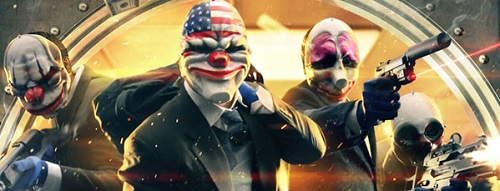
Worth Writing Home About: Payday 2 Beta
So it's a little known fact about me that I am a complete sucker for online shooters. Not your Quakes or your Counter-Strikes, mind you - they're for children and grown adults who still have the superior reaction times of children. No, I like my shooters the way I like everything in life - just a little bit different. Payday was one of those shooters.
Both games in the series have you and three others tackle criminal jobs from bank heists to drug heists to... jewel heists (you get the picture) and you do this in general by completing objectives (drill the bank vault, signal the boat, find the explosives etc). Hindering you in this regard are many, many policemen. The games could be described as L4D with cops instead of zombies, but to be honest that might be overselling Payday's AI. Here are some of the ways in which Valve's zombies are smarter / more plausible than Payday's people:
- Zombies run on curved lines, making them more organic-seeming and less predictable.
- Cops run in straight lines.
- Zombies take tactical advantage of their strengths and weakness (ie they run at you as soon as they see you).
- Cops take almost no tactical advantage of their strengths and weaknesses (ie they run at you as soon as they see you).
- Zombies die when you shoot them in the face.
- Cops die when you shoot them in the face three or four times.
I loved the first game despite its laughable AI. I guess I did so primarily because it was a riff on the L4D formula, which itself is still fresh enough to support similar products with different body paint. Payday delivered the same style of frantic co-op drama that Turtle Rock's zombie game did, but I think profited from more varied objectives contextualised by a heist movie setting that's more interesting and liberating than L4D's get-to-the-chopper overtones. It's fun to shoot zombies with your mates; but it's more fun (at least in principle) to stride into a bank and tell everyone to get down while your mates disable the cameras and beat the vault codes out of the manager. Payday 1, then, was an average co-op shooter with horrible AI, but it was attached to a compelling and ambitious setting.
The first thing to say about the sequel is that it does everything except fix the one bit that needed to be. For all of Payday's reactive, multi-stage missions, for all of its weapon customisation, enhanced stealthing and more varied heists... no matter how much you enjoy these things (and I have done) the core of the game will be waiting just around the corner to slap you over the head and remind you that you're not an awesome super-crook; you're just a guy (can you use 'guy' as a unisex term in this way? Discuss.), in a game, pretending to be a super-crook by shooting dozens of zombie cops in the face (many times each).
The second thing to say is that a bunch of other stuff has changed. There is now a more extensive, XP-based weapon and character customisation system. Enough said about that. There is also a broader range of stealth options in the levels themselves, which is appreciated. It's still bloody hard to pull off a stealth run (and when one goes wrong it's doubly depressing that the relative complexity of the stealth systems isn't reflected in the relentless combat that your bumbling has triggered); but it's eminently more possible than it was in the first game, and more interesting to do, too.
The scale of the levels has been altered too. It's worth noting that this is only the beta, and it comes with what I assume is a fraction of the full complement of maps (it's less than ten at the mo), but what is available is on a much smaller scale than the last batch. Gone are the days of being spread out over a vast complex of rooms and corridors; now we have much more intimate spaces. It feels less dynamic, but more plausible. It's hard to believe anything that happens in these games, but I guess four men are more likely to hold up a two storey jewelry shop on the high-street than a banking conglomerate. Sadly one repercussion of pinning the players into small spaces seems to have been the complete paralysis of the mission design team. Tasked with finding reasons to keep the criminal gang in a specified location for a particular length of time, the only thing they've been able to come up with is to drill holes in things, which takes loads of time, apparently, and is subject to frequent mechanical hitches. When you're not waiting for a drill to finish you're waiting for a van (or a boat, or a helicopter) to show up and whisk away the money. I know this happened a lot in the first game, too; but it seems worse here. No level has more than two real objectives: get the money, get out. I realise that's what a heist is, but what happened to interrogating bank managers, blowing through roofs and freeing captive prisoners?
Again, I should note that there's loads of the game I've not seen yet; but what I have seen doesn't fill me with confidence. Presumably the downsizing was in order to make way for the series' new USP: the multi-stage missions where events in later maps are determined by performance in the earlier ones. Sadly there's only one mission available with three stages at the mo, so I can't comment on how well that's working.
I'm aware that this is sounding a bit overwhelmingly negative. I don't mean it to - I've had fun with Payday 2, and I'm dying to see the new maps. I love the efforts Overkill have gone to to make this a world, not just a series of missions. I like being able to see my money and guns on a table in my safehouse, and getting a little audio briefing before a job. The guns are meatier too. It's just that I wish all these cool things were built around a better, more plausible game. Payday has always been close to delivering a truly special experience; the holistic career criminal experience. All it would take is half the cops with twice the brains. I appreciate that one little sentence entails years of work, but I think Payday is worth it. I like interacting with other people in more interesting ways than shooting them multiple times in the face, and Payday is still one of the best opportunities to do that.
I probably shouldn't score this since it's only a beta, but I think you're smart enough to appreciate that and judge accordingly.
Polish: 1 out of 2
Tilt: 1 out of 2
(Scoring explained here)
Payday 2 is available on Steam for £24.99, or £29.99 for instant beta access.
Wednesday, 3 July 2013
Free Indie Game: Outer Wilds
Monday, 24 June 2013
The Games You Must Have Played in 2012/13 - Part 2
Part 1 here.
Mark of the Ninja
Another Klei title? Definitely. Mark the Ninja, as he is called by sensible people, has an excellent stealth game built around him. While we seem to be rather spoilt for indie stealth titles at the moment (Monaco, Gunpoint, The Swindle...), Mark stands out for being a purer implementation of the ideal, for being rather more substantial in terms of content, and for actually being released. There's also a story packed in there with a fun twist, though it's perhaps not what you'll really be savouring.
Also ninjas.
Also I was reminded in San Francisco that Klei started out with Eets, which I recall from a long lost era when indie games weren't so much of a thing, and which I'm told was the first indie game ever on Steam, which is pretty weird to think about.
Monaco
I really wasn't sure I was going to like Monaco. A quick play at PAX last year only exposed me to the quick-fire chaos of a noob game, and I didn't want arcade, I wanted stealth. Turns out it's my favourite game of the year so far.
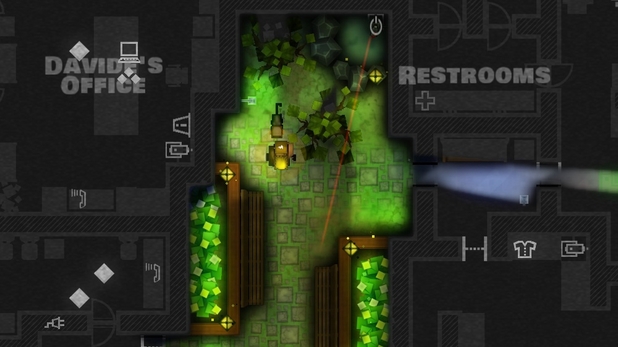
The devs are right when they say whatever game you want from Monaco is in there somewhere. Soloing each level, taking it slow and methodical, is possible and highly rewarding, but playing with a reasonably experienced team is even more so. It's amazing how quickly you get comfortable enough with the mechanics to start improvising on the move.
Monaco is a brilliant co-operative stealth game that is worth every single penny, and that's all I'm going to say about it. Oh, and the map editor iscoming out soon, apparently, out now in beta, and I am excited. have made a level.
The Walking Dead
And finally, because I'm super lazy and want to go play Don't Starve / read about political justifications for environmentalism / have a smoke / write a Swapper post-mortem... I will simply say: play The Walking Dead. It is amazing, there is new DLC coming out, and I will be surprised if it doesn't take the Writers' Guild of Great Britain Award this year. Oh, and the first episode is free on iPad. Boom.
Mark of the Ninja
Another Klei title? Definitely. Mark the Ninja, as he is called by sensible people, has an excellent stealth game built around him. While we seem to be rather spoilt for indie stealth titles at the moment (Monaco, Gunpoint, The Swindle...), Mark stands out for being a purer implementation of the ideal, for being rather more substantial in terms of content, and for actually being released. There's also a story packed in there with a fun twist, though it's perhaps not what you'll really be savouring.
Also ninjas.
Also I was reminded in San Francisco that Klei started out with Eets, which I recall from a long lost era when indie games weren't so much of a thing, and which I'm told was the first indie game ever on Steam, which is pretty weird to think about.
Monaco
I really wasn't sure I was going to like Monaco. A quick play at PAX last year only exposed me to the quick-fire chaos of a noob game, and I didn't want arcade, I wanted stealth. Turns out it's my favourite game of the year so far.
The devs are right when they say whatever game you want from Monaco is in there somewhere. Soloing each level, taking it slow and methodical, is possible and highly rewarding, but playing with a reasonably experienced team is even more so. It's amazing how quickly you get comfortable enough with the mechanics to start improvising on the move.
Monaco is a brilliant co-operative stealth game that is worth every single penny, and that's all I'm going to say about it. Oh, and the map editor is
The Walking Dead
And finally, because I'm super lazy and want to go play Don't Starve / read about political justifications for environmentalism / have a smoke / write a Swapper post-mortem... I will simply say: play The Walking Dead. It is amazing, there is new DLC coming out, and I will be surprised if it doesn't take the Writers' Guild of Great Britain Award this year. Oh, and the first episode is free on iPad. Boom.
Tuesday, 11 June 2013
The Games You Must Have Played 2012/13 - Part 1 of 2
There was a time on this blog when I did previews and recommended games and things, and that time is returning... NOW! I've been stuck in exams and The Swapper crunch for the last month or three, but no longer.
Every week I play games that are worth writing about. I rarely actually write because the internet is full of such things, and actually lists are a bit time consuming to write; but it is worth doing if even one person comes here and is sold on a game they'd not gotten around to yet, so here we go. These are the games that stirred that childhood emotion inside me of wonder and delight over the last year.
XCOM: Enemy Unknown
My word does XCOM make me realise how much TBS fans have been hard done by over the past decade, and how glad I am those days are over. Frozen Synapse reinvigorated my interest in the genre, and games like Memoir '44, Hero Academy and Rad Soldiers have been sustaining it. XCOM well and truly sates it.
It's hard not to admit that a big part of XCOM's appeal is in the looks (especially with the HD mods). The cover system is similar in function to Rad Soldiers' (though far more nuanced than), but seeing your people actually dashing for cover in roadie-cam, being pinned down by suppressing fire and shying away from incoming fire actually makes me feel like a commander. Sure the animation and clipping is still seriously rough really quite frequently, but who cares?
The meta-game deserves mention as well. While it's not as involved as the classics, it does a decent enough job of representing to you the global view, and the dramatic progress that you're making. I love the X-Com experience more than anything because it's holistic: I don't feel like I'm playing a game, I feel like I'm defending the world from aliens.
Don't Starve
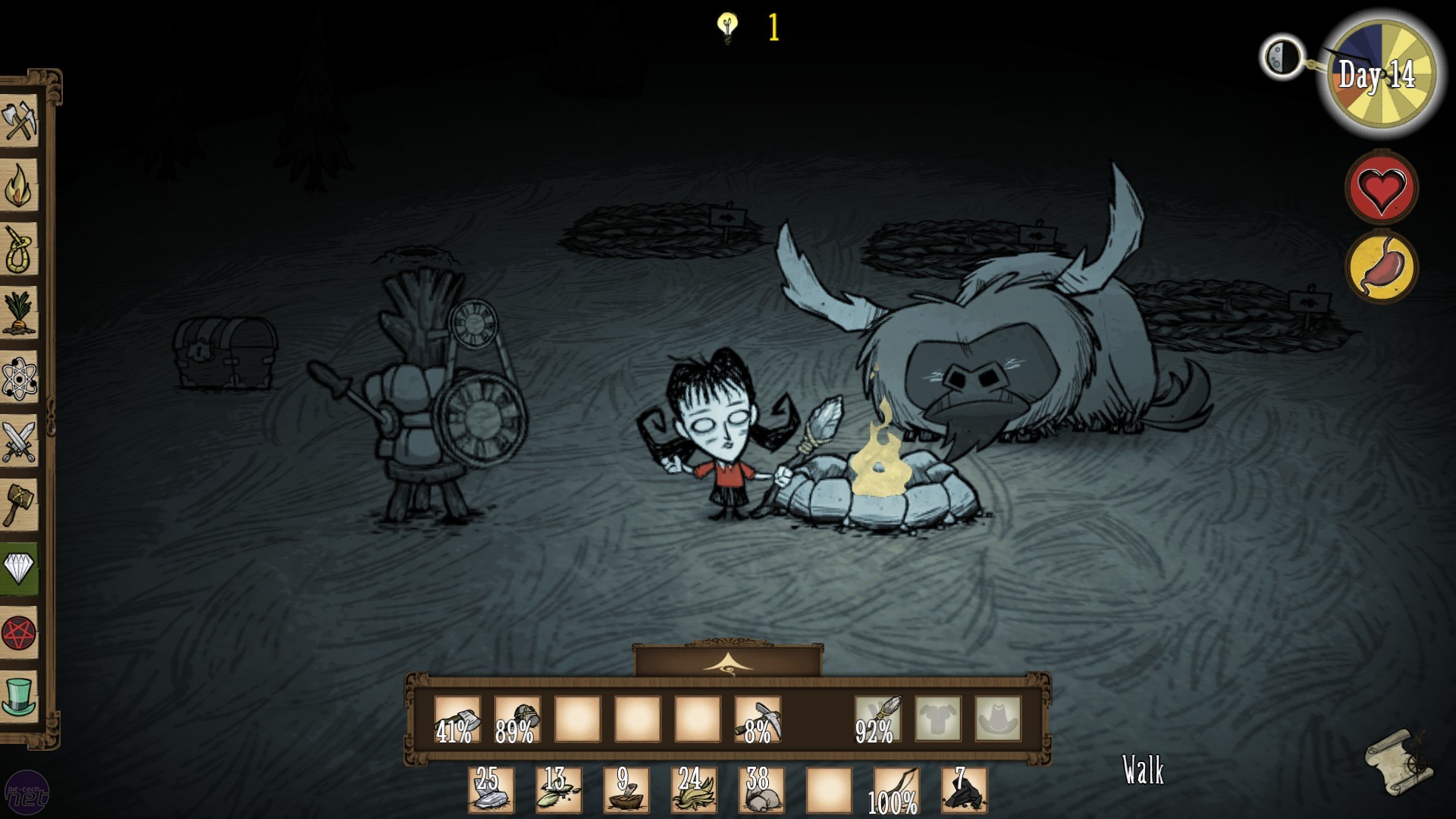
If I'm honest, I've not booted Don't Starve since it officially released. It hit that point for me where I hadn't played in a while, and I couldn't bring myself to make the reinvestment in the perma-death only to starve gruesomely yet again. Don't Starve, it's true, has a bunch of features that distance me from it. There's not enough hand-holding for me - I like feedback from a game that I'm doing something significant, even if it's only a few lines of text. There's a bit of grind in the Minecraft-y elements as well, and frankly clicking on tiles all day so I can make my garden more aesthetically pleasing isn't the sort of activity I'm ever likely to engage in voluntarily.
None of this is to say I didn't thoroughly enjoy the hours I put in during the beta. I love Don't Starve because it's one of the best survival games I've played. I love dynamic systems, I love fleshed out worlds, and Don't Starve's nightmare wilderness is at once fascinating, fluid and convincing.
Journey
Quite apart from its lovely aesthetic, Journey was an important game for me for its 'co-op'. By eliminating almost all interaction, and then placing players in that beautiful, ever shifting desert Journey achieves that most difficult of goals: it takes the general awfulness of people on the internet and turns it into something wonderful. Okay, perhaps the way I've described this makes Journey a sort of lobotomy: take all the tools away from people and they've got no choice but to be nice; but play through the game to the end with someone you'll never know and tell me you didn't appreciate it.
Part 2 next week.
Every week I play games that are worth writing about. I rarely actually write because the internet is full of such things, and actually lists are a bit time consuming to write; but it is worth doing if even one person comes here and is sold on a game they'd not gotten around to yet, so here we go. These are the games that stirred that childhood emotion inside me of wonder and delight over the last year.
XCOM: Enemy Unknown
My word does XCOM make me realise how much TBS fans have been hard done by over the past decade, and how glad I am those days are over. Frozen Synapse reinvigorated my interest in the genre, and games like Memoir '44, Hero Academy and Rad Soldiers have been sustaining it. XCOM well and truly sates it.
It's hard not to admit that a big part of XCOM's appeal is in the looks (especially with the HD mods). The cover system is similar in function to Rad Soldiers' (though far more nuanced than), but seeing your people actually dashing for cover in roadie-cam, being pinned down by suppressing fire and shying away from incoming fire actually makes me feel like a commander. Sure the animation and clipping is still seriously rough really quite frequently, but who cares?
The meta-game deserves mention as well. While it's not as involved as the classics, it does a decent enough job of representing to you the global view, and the dramatic progress that you're making. I love the X-Com experience more than anything because it's holistic: I don't feel like I'm playing a game, I feel like I'm defending the world from aliens.
Don't Starve
If I'm honest, I've not booted Don't Starve since it officially released. It hit that point for me where I hadn't played in a while, and I couldn't bring myself to make the reinvestment in the perma-death only to starve gruesomely yet again. Don't Starve, it's true, has a bunch of features that distance me from it. There's not enough hand-holding for me - I like feedback from a game that I'm doing something significant, even if it's only a few lines of text. There's a bit of grind in the Minecraft-y elements as well, and frankly clicking on tiles all day so I can make my garden more aesthetically pleasing isn't the sort of activity I'm ever likely to engage in voluntarily.
None of this is to say I didn't thoroughly enjoy the hours I put in during the beta. I love Don't Starve because it's one of the best survival games I've played. I love dynamic systems, I love fleshed out worlds, and Don't Starve's nightmare wilderness is at once fascinating, fluid and convincing.
Journey
Quite apart from its lovely aesthetic, Journey was an important game for me for its 'co-op'. By eliminating almost all interaction, and then placing players in that beautiful, ever shifting desert Journey achieves that most difficult of goals: it takes the general awfulness of people on the internet and turns it into something wonderful. Okay, perhaps the way I've described this makes Journey a sort of lobotomy: take all the tools away from people and they've got no choice but to be nice; but play through the game to the end with someone you'll never know and tell me you didn't appreciate it.
Part 2 next week.
Friday, 11 January 2013
Little Inferno & Plato's Allegory of the Cave
I played Little Inferno just before Christmas. Like others I found the simplicity of the gameplay a little underwhelming compared with the ingenious developments of previous Kyle Gabler offering, World of Goo; unlike some others I found real depth to the game's fiction. This post is about that.
Little Inferno isn't just a simplistic game of burning amusing objects in different combinations to score points - it's one in a very familiar mould. Perhaps I've been reading too much Plato recently, but that seems to me rather like the point. Let me explain.
I Think Little Inferno is Plato's Allegory of the Cave
In The Republic, Socrates asks his audience to imagine a cave in which slaves are incarcerated. They are held in place by shackles, forced to stare at a wall. Their captors stand behind them, using puppets and firelight to cast shadows onto the wall. All the slaves know of the world are the shadows before them.
Socrates then asks what would happen if one of these people was to be released and allowed to look upon the puppeteers. The slave would be shocked and confused at first; but in time they would come to realise that the shadows were mere illusions, and that the real cause of them was the puppets. Next the freed slave emerges from the cave and, though blinded by the light, learns another level of truth - the puppets were themselves only copies of real animals which the puppeteers were mimicking. Finally the slave looks up at the sun, and realises that every object perceived so far is reliant upon it, both for their continued existence and for the slave's ability to see them.
The idea is that the slave's journey mirrors our own intellectual journeys as human beings. We begin life taking the information from our senses to be the ultimate truth. Some never leave this state. Others look around and realise that there are greater forces at work which themselves explain the information received by our senses. As the slave leaves the cave and witnesses the real world, human beings are able to engage their rational thought and begin reasoning out the truth from the lies. Finally, we are supposed to come upon the ultimate truth, or the Form of the Good, which is analogous to the sun, and represents ultimate enlightenment for Plato.
And in the Game
Major plot spoilers from here on out.
Little Inferno sees you play as a faceless, nameless character who stares at a fireplace and burns things. Everything you know about the world is arrived at through letters which are opened in front of the fireplace and then burned. You engage in a repetitive, simplistic activity which - while amusing - is ultimately demeaning. As a player you're engaging in a format designed to waste time; as a character you're burning up all your worldly possessions just to stay warm, all the while being reassured by the manufacturer that what you're doing is fun.
The parallels are pretty thick. As the game progresses your nextdoor neighbour - who so far has only been present in letters - becomes more and more physical. Things she does affect your game and make you aware for the first time that you're not staring at a gameboy screen, you're staring at a wall, in a house, next to another house, in a town... There's a whole world outside this cave!
When the denouement comes it's unexpectedly different to the last 4 hours. Everything you learnt in that time becomes useless in the broader context. Despite never having thought about it before, you learn that those letters were being delivered by a postman/puppeteer you could never actually turn around to see. You're told you can do whatever you like, but that you can never go back. Then the skies clear, the sun comes out, and the weather man takes you up in his balloon to see it all.
The Difference
There's one quite radical difference between Plato's version and Tomorrow Corporation's, which is that Plato's philosopher is supposed - once enlightened - to return to the cave and to govern it using all that acquired wisdom. I suppose in a sense that's what the weather man does, though by blowing up the player character's house the game does rather put an exclamation mark on the no returns policy.
Perhaps the journey depicted here is that of the developers - starting out in the dark, struggling to make ends meet, then joining a huge corporation and finally seeing the light at the end of the tunnel. Perhaps Little Inferno as a product is analogous to the enlightened one returning to the cave and translating their new knowledge into something those still shackled to the wall can understand; or maybe that's going too far.
Perhaps Tomorrow Corporation aren't entirely sold on Plato's metaphysical and political manifesto, and the allegory of the cave is just a resonant metaphor for people waking up and taking charge of their lives instead of wasting them.
After all, you don't need to believe in philosopher-kings, ritualistic group marriage or god to believe in that.
Tuesday, 27 November 2012
Hitman: Absolution: In Support Of
Absolution also got me thinking about Hitman's oft-fraught relationship with narrative, and about how the bland cutscenery of the last two games seems to be missing the point. I love IO and I love these games - and I want to formulate something constructive. To do so I'll ask a simple question:
What is the point of Hitman's Narrative?
The narrative design in a game is there with one purpose, which is the same purpose as every other element in development - to help deliver an interactive experience that focuses on the controlling idea. The controlling idea is what the project is about. It's a description of what the end-user experience should be.
Hitman's controlling idea (its point) is plain enough: to be an expert assassin; to explore, understand and violently participate in a living world. By focusing on realistic environments, psychological judgements (or understanding of AI routines if we're being cynical) and calculated subterfuge over blind Rambo-ism, Hitman is, more than most stealth 'n gun games, a simulator. Albeit a simulator with a dark sense of humour.
How do you usually plot a simulator?
Usually not with cutscenes. The more popular alternative is simply to avoid plot altogether. A plot supposes some artificial linearity - some element of the game that isn't simulated, but locked in - and that would be opposed to the very concept of what a simulator is. Silent Hunter, SWAT 4, the various brilliant flight sims - they don't force you on a particular path. They give you enough background detail for context, then let you go off and create your own tale.
I'm not sure this is where Hitman's going. For one thing, Hitman is different from some other simulators in having a protagonist with a personality (sort of) and - so the argument goes - therefore you need a character arch, and a plot, and cutscenes... we know where this ends up. For another thing - and it seems strange to admit this - but I just can't imagine Eidos biting the bullet and accepting that they may not need a plot. Hitman is a AAA game, and AAA games have stories now!
So if we're committed to putting something in between the assassinations (and it is surely the assassinations that are at the heart of Hitman) what should it be?
How else could you design Hitman's narrative?
How about this: Career Mode. I'd argue that if we want anything from Hitman's narrative, it would be something that supports the simulation feel of the core gameplay. What's cool about 47 is not, I think, what he does when the people he works for betray him and he's left with a genetically engineered little girl to protect. What's cool about 47 is that he's a professional. A cool Hitman story would focus on that.
What would a year in the career of a Hitman be like? What would fill the gaps between the hits? I think there would probably be a bunch of the things you'd expect - upgradeable, explorable hideouts, collectable weapons, a currency based on mission success... You'd also want to make greater use of some other elements from earlier Hitman games - Blood Money's procedural newspaper articles could be developed into something that gave us a sniff of the larger world.
What might turn out to be particularly useful are those little vignettes from Absolution. A career mode would need something more than a few management elements to deliver the sense of being 47. We'd want to see just a little of the pain-staking preparation that goes on behind the scenes. So perhaps we'd have some side-missions: a trip to the blackmarket weapons dealer, a hit on a potential witness, a scouting mission on local police patrols. If we were really clever we'd have these develop and overlap in unexpected ways: perhaps on the scouting mission we'll spot the weapons dealer entering the police station. Depending on 47's actions he may come home from his next mission to find them knocking at his door.
What I suggest is that by building up this little web of fiction we could bring another layer of detail to Hitman's world. Instead of breaking from the core missions for another video of 47 being betrayed and not being caring about it, let's use that time to tell a different sort of story - one which reflects the core themes of the gameplay experience. One which makes you feel like a Hitman.
I'm not sure this is where Hitman's going. For one thing, Hitman is different from some other simulators in having a protagonist with a personality (sort of) and - so the argument goes - therefore you need a character arch, and a plot, and cutscenes... we know where this ends up. For another thing - and it seems strange to admit this - but I just can't imagine Eidos biting the bullet and accepting that they may not need a plot. Hitman is a AAA game, and AAA games have stories now!
So if we're committed to putting something in between the assassinations (and it is surely the assassinations that are at the heart of Hitman) what should it be?
How else could you design Hitman's narrative?
How about this: Career Mode. I'd argue that if we want anything from Hitman's narrative, it would be something that supports the simulation feel of the core gameplay. What's cool about 47 is not, I think, what he does when the people he works for betray him and he's left with a genetically engineered little girl to protect. What's cool about 47 is that he's a professional. A cool Hitman story would focus on that.
What would a year in the career of a Hitman be like? What would fill the gaps between the hits? I think there would probably be a bunch of the things you'd expect - upgradeable, explorable hideouts, collectable weapons, a currency based on mission success... You'd also want to make greater use of some other elements from earlier Hitman games - Blood Money's procedural newspaper articles could be developed into something that gave us a sniff of the larger world.
What might turn out to be particularly useful are those little vignettes from Absolution. A career mode would need something more than a few management elements to deliver the sense of being 47. We'd want to see just a little of the pain-staking preparation that goes on behind the scenes. So perhaps we'd have some side-missions: a trip to the blackmarket weapons dealer, a hit on a potential witness, a scouting mission on local police patrols. If we were really clever we'd have these develop and overlap in unexpected ways: perhaps on the scouting mission we'll spot the weapons dealer entering the police station. Depending on 47's actions he may come home from his next mission to find them knocking at his door.
What I suggest is that by building up this little web of fiction we could bring another layer of detail to Hitman's world. Instead of breaking from the core missions for another video of 47 being betrayed and not being caring about it, let's use that time to tell a different sort of story - one which reflects the core themes of the gameplay experience. One which makes you feel like a Hitman.
Thursday, 16 August 2012
Stories in Unlikely Places: Conker's Bad Fur Day
Things change fast around here. One minute we're making platformers about plumbers, the next we're doing high resolution first-person shooters, and then before you know it we're doing platformers again, only different.
Conker's Bad Fur Day both fell foul of that particular fact, and embodied it. One of the very last games to be released on the N64, it looked for all the world like the last of the old guard Nintendo platformers. In 2001 we were beginning to move beyond the cartoon simplicity that had satisfied us for so long - more adult, and lavishly detailed experiences like Silent Hill were drawing audiences away from the Gamecube and toward the PS2 - and Conker languished in the purgatory between hardware cycles. It sold 55,000 copies.
But Conker was a sign of things to come. It played like any other Rare platformer (and, I'd say, was the best of the lot at just that), but it was radically different in tone and style. It was rude. It was self-referential. It took the piss out of games, films and itself in equal measure. In short - it was way ahead of its time.
FRANKYI is gonna stick my big fork right in your ass!
The game follows Conker who, after a particularly heavy night on the town, winds up on a fateful trajectory that will see him become the King of the Land. While that story sees him do all the usual things - collect keys, jump on bad guys, solve puzzles - his priorities throughout have more in common with those of Animal House than Banjo or Diddy Kong. Conker would fuck those guys up. He might even wave his squirrel bits at them.CONKERWere you parents related? Like before they were married?
Throughout the game you can just feel the guys at Rare letting loose with not only their many years' experience with the genre, but their love for it. Of course, this is also the last cute-animal-platformer Rare released on console (barring re-releases and the construction-focused Nuts & Bolts) and so it's most interesting to observe the criticism of the form that's ever-present in Conker. From keys that refuse to be collected to boss battles that are literally the crappiest part of the game, there was a sense that Rare was looking to what games were going to become rather than what they'd always been content to be. Their switch from Nintendo to Microsoft came one year later.
Looking at the game today, it's not quite as sharp as it once was, because Conker was one of the first AAA games to try to break out from being just the sum of its parts. It suffers because we've gotten so much better at doing that. This said, it's still a game which chooses to, at one point, put a cartoon squirrel in the middle of an animal-based Omaha beach landing. It's still a game where the princess, instead of baking you a cake, calls you on your cell and gives you shit for not coming home, before donning leather and joining you in a Matrix-inspired lobby shootout.
Better, the Xbox remake still looks fantastic. If you've got one in the cupboard / are of an emulation disposition then I'd unconditionally recommend you play it. It's a vital and always entertaining part of history that only 55,000 other people have shared.
Tuesday, 17 April 2012
Mass Effect 3 vs Skyrim: Worth Writing Home About?
Two rather major RPGs came out in recent months. ME3 I eagerly anticipated, having found No.2 a radical gameplay improvement on the first, but losing all my saves before I finished it. The Elder Scrolls I've always found less love for - its writing, acting and branching is less advanced, and (as has been noted before) it feels like an MMO without the other people. Here's what I think now, having played through a reasonable amount, though not all, of the content in each.
Mass Effect 3
The big news for me was this: Mass Effect 3, like Dragon Age 2 before it, feels like a stripped back version of its predecessor. This looks like a finished game; but the RPG elements all feel tacked on, and the combat remains inferior to a dedicated action game.
We know, of course, that the RPG elements aren't really meant to be inferior; they've just been 'streamlined'. Perhaps that's a way of saying 'more accessible to console players', perhaps it means 'reduced in scope in order to meet the tight deadine'. Either way Bioware seem certain of their trajectory, and sales figures would seem to support that; but as far as I'm concerned they've gutted their RPG.
Each of these factors is minor in its own right, but between them they add up to a deeply dissatisfying experience when compared with ME2):
- Special abilities feel like magic rather than tech. Grenades and special bullets aren't thrown or fired, they just materialise at the target. Tech discovered in the field is scanned by your magic arm and then disappears.
- Shopping, trading and weapon customisation is drastically simple.There's next to no mythology here, or discovery: just buy the Mk IV version of your assault rifle and crack on. Like ME2, shops themselves are accessed via a computer interface, removing any remaining sense that this is anything but a statistical level up.
- There are no more large hub areas, only smaller ones connected by lift. I grant that in function five small areas is no different to one large one, but again it demonstrates this unwillingness on Bioware's part to allow suspension of disbelief to get in the way of functionality.The citadel was once a huge, exciting place filled with sub-quests, engaging characters and hidden gems in back street traders. Now you run from lift to office, trigger that conversation, then head back for the lift. Even the traders can be accessed remotely from the Normandy. There is an entire, three floor night club in the game; it has two talkable NPCs, of which one is already on your team.This doesn't feel like a world, it feels like the mechanical foundations of a world.
- The levels themselves feel far more like generic man-shoots than they ever did. Most are set in brown, debris-covered battlefields where you fight the same old guys again and again. Your squad is largely useless. There's little story here: few in depth conversations, no interesting cut scenes, just 'Go here, retrieve this, kill these dudes'. There's no sense that these are real places, or anything other than a set of corridors between combat scenes. Readable notes are few and far between, and strangely arbitrary in their content. Datapads are as likely to win you credits as information. Medkits for some reason give you XP.
- Perhaps most damningly, the dialogue system has been further simplified. Gone is any pretence that conversations are anything but formally structured. It becomes de rigeuer: someone says something, you can ask more, or you be can nice or nasty. The latter affects your paragon bar and little else. How it affects the bar is familiarly flawed. Even the way secondary missions are now issued suggests Bioware's faith in its audience's willingness to put up with dialogue is fast dwindling: now you only need walk past and overhear a dialogue in the hub to be issued that mission; often it pops up in your (rather uninformative) journal and you're left with no idea where it came from.
It pains me to say it, but ME3 feels founded in the (perhaps justified for many consumers) belief that we don't need dramatic dressing up of the mechanics provided the mechanics themselves work as expected. I know that Mass Effect is pretty, and has reasonable shooting, and has a far more involved narrative than any other action game you care to mention. I think, though, that it finally deserves to be considered in these terms (as action game first), and not the way that it started life. This is a Call of Duty behemoth that will continue to succeed on the momentum of its marketing and the maintenance of its core systems; but it stopped being a Bioware RPG some time ago.
The Elder Scrolls V: Skyrim
Frankly, everything I liked and disliked about Oblivion still holds for Skyrim. The writing isn't always the most interesting (and is certainly more verbose than is necessary, but I often feel like that's half the point). There's next to no roleplaying, decision making or involvement in narrative beyond the choice of which quests you take on. The world itself is as impressive and free as ever.
As is usually noted, Skyrim is at its strongest when you, the player character, take your fate in your hands. Played the completionist way I traditionally play RPGs it all falls apart: try to explore every town, complete every quest and you'll quickly loose track of exactly why you're in another haunted crypt, what you're looking for, and who you are and what your story is. You relegate the game to its base combat mechanics.
The beauty of Skyrim is that through its comparatively simplistic questing system it's able to provide an incredibly open experience. First few quests aside, I couldn't care less that I'm a 'Dragonborn'; if it weren't for the beautiful pilgrimage up to the snowy mountain peak I wouldn't have bothered finding out. What I really wanted to do was trek across to the Bard's College in Solitude and earn my stripes as a wordsmith. I recovered a lost manuscript, helped my tutor to fill in the blanks, and then presented it to the Jarl as a way to defend the freedom of speech festival that was under threat of a ban. These are my priorities, this is the person I'm playing, and this is my story. Skyrim works much better when you follow single threads to their completion; when you put the story (both written and constructed by you on the fly) at the centre of the experience. Suddenly all those shopkeepers with all those fetch quests and optional anecdotes slip into a more natural role. If you need a new tunic, Wolfgar's heard there's a well-regarded retailer's in Winterhelm. You may or may not care. Being picky about the quests you take on keeps those you do coherent with your character and your story. And when it works it's engaging.
What I hate about Skyrim is that it feels - for me sooner rather than later - so shallow. Sure it's huge, sure it's detailed. But ultimately it's about running places and hitting things with swords, and often under the lightest and least inventive of pretences. It's such a shame that being a bard in training is so remarkably similar to being a warrior in training: go to this dungeon, collect three magic weapons / musical instruments. Ultimately the game falls down in just the same way GTA sometimes does: for all its surface glamour, for its high production values and efforts to skin the experience with an involving story and detailed open world, it all eventually boils down to going somewhere and killing everyone. Games like Heavy Rain and Planescape showed us that story can be more central to gameplay than that, and that just because your core gameplay loop is combat-based doesn't mean every experience has to be along the same lines.
Mass Effect 3
We know, of course, that the RPG elements aren't really meant to be inferior; they've just been 'streamlined'. Perhaps that's a way of saying 'more accessible to console players', perhaps it means 'reduced in scope in order to meet the tight deadine'. Either way Bioware seem certain of their trajectory, and sales figures would seem to support that; but as far as I'm concerned they've gutted their RPG.
Each of these factors is minor in its own right, but between them they add up to a deeply dissatisfying experience when compared with ME2):
- Special abilities feel like magic rather than tech. Grenades and special bullets aren't thrown or fired, they just materialise at the target. Tech discovered in the field is scanned by your magic arm and then disappears.
- Shopping, trading and weapon customisation is drastically simple.There's next to no mythology here, or discovery: just buy the Mk IV version of your assault rifle and crack on. Like ME2, shops themselves are accessed via a computer interface, removing any remaining sense that this is anything but a statistical level up.
- There are no more large hub areas, only smaller ones connected by lift. I grant that in function five small areas is no different to one large one, but again it demonstrates this unwillingness on Bioware's part to allow suspension of disbelief to get in the way of functionality.The citadel was once a huge, exciting place filled with sub-quests, engaging characters and hidden gems in back street traders. Now you run from lift to office, trigger that conversation, then head back for the lift. Even the traders can be accessed remotely from the Normandy. There is an entire, three floor night club in the game; it has two talkable NPCs, of which one is already on your team.This doesn't feel like a world, it feels like the mechanical foundations of a world.
- The levels themselves feel far more like generic man-shoots than they ever did. Most are set in brown, debris-covered battlefields where you fight the same old guys again and again. Your squad is largely useless. There's little story here: few in depth conversations, no interesting cut scenes, just 'Go here, retrieve this, kill these dudes'. There's no sense that these are real places, or anything other than a set of corridors between combat scenes. Readable notes are few and far between, and strangely arbitrary in their content. Datapads are as likely to win you credits as information. Medkits for some reason give you XP.
- Perhaps most damningly, the dialogue system has been further simplified. Gone is any pretence that conversations are anything but formally structured. It becomes de rigeuer: someone says something, you can ask more, or you be can nice or nasty. The latter affects your paragon bar and little else. How it affects the bar is familiarly flawed. Even the way secondary missions are now issued suggests Bioware's faith in its audience's willingness to put up with dialogue is fast dwindling: now you only need walk past and overhear a dialogue in the hub to be issued that mission; often it pops up in your (rather uninformative) journal and you're left with no idea where it came from.
It pains me to say it, but ME3 feels founded in the (perhaps justified for many consumers) belief that we don't need dramatic dressing up of the mechanics provided the mechanics themselves work as expected. I know that Mass Effect is pretty, and has reasonable shooting, and has a far more involved narrative than any other action game you care to mention. I think, though, that it finally deserves to be considered in these terms (as action game first), and not the way that it started life. This is a Call of Duty behemoth that will continue to succeed on the momentum of its marketing and the maintenance of its core systems; but it stopped being a Bioware RPG some time ago.
Polish: 1 out of 2
Tilt: 0 out of 2
The Elder Scrolls V: Skyrim
Frankly, everything I liked and disliked about Oblivion still holds for Skyrim. The writing isn't always the most interesting (and is certainly more verbose than is necessary, but I often feel like that's half the point). There's next to no roleplaying, decision making or involvement in narrative beyond the choice of which quests you take on. The world itself is as impressive and free as ever.
As is usually noted, Skyrim is at its strongest when you, the player character, take your fate in your hands. Played the completionist way I traditionally play RPGs it all falls apart: try to explore every town, complete every quest and you'll quickly loose track of exactly why you're in another haunted crypt, what you're looking for, and who you are and what your story is. You relegate the game to its base combat mechanics.
The beauty of Skyrim is that through its comparatively simplistic questing system it's able to provide an incredibly open experience. First few quests aside, I couldn't care less that I'm a 'Dragonborn'; if it weren't for the beautiful pilgrimage up to the snowy mountain peak I wouldn't have bothered finding out. What I really wanted to do was trek across to the Bard's College in Solitude and earn my stripes as a wordsmith. I recovered a lost manuscript, helped my tutor to fill in the blanks, and then presented it to the Jarl as a way to defend the freedom of speech festival that was under threat of a ban. These are my priorities, this is the person I'm playing, and this is my story. Skyrim works much better when you follow single threads to their completion; when you put the story (both written and constructed by you on the fly) at the centre of the experience. Suddenly all those shopkeepers with all those fetch quests and optional anecdotes slip into a more natural role. If you need a new tunic, Wolfgar's heard there's a well-regarded retailer's in Winterhelm. You may or may not care. Being picky about the quests you take on keeps those you do coherent with your character and your story. And when it works it's engaging.
What I hate about Skyrim is that it feels - for me sooner rather than later - so shallow. Sure it's huge, sure it's detailed. But ultimately it's about running places and hitting things with swords, and often under the lightest and least inventive of pretences. It's such a shame that being a bard in training is so remarkably similar to being a warrior in training: go to this dungeon, collect three magic weapons / musical instruments. Ultimately the game falls down in just the same way GTA sometimes does: for all its surface glamour, for its high production values and efforts to skin the experience with an involving story and detailed open world, it all eventually boils down to going somewhere and killing everyone. Games like Heavy Rain and Planescape showed us that story can be more central to gameplay than that, and that just because your core gameplay loop is combat-based doesn't mean every experience has to be along the same lines.
Polish: 1 out of 2
Tilt: 0 out of 2
(Scoring explained here)
Subscribe to:
Posts (Atom)