Showing posts with label industry. Show all posts

Thursday, 20 October 2016

A Change in Circumstances

Around 8 years ago I had just two games to my name: Penumbra: Overture and Black Plague. I was working fulltime for www.gameshadow.com as editor/content manager, my first job out of uni, and desperately hoping I could find a way to support myself with creative writing alone.

That didn't happen, and in late 2008 I was let go. It was exciting, but difficult, because for the first time I faced the reality that if I couldn't make enough money in the immediate future to pay the bills from making video games I would have to do something drastically responsible, like become a barrister, or a civil servant instead.

Fortunately, and partly due to wonderful people like Gordon Rennie and Andy Walsh supporting me, I was already in touch with a fledgling games writers' agency called Sidelines. It was an offshoot of what remains one of the UK's best (IMO) video game recording studios, Side, and signing up with them secured me work on a bunch of AAA projects such as Driver and Binary Domain. While those two games are the exception in so far as they were actually completed, that string of AAA work from '08 - '12 kept me busy and kept the bills paid until such time as my work on games like FTL and The Swapper was drawing enough attention that I could be more selective about the projects I took on, and stop worrying so hard about what came next.

Now Sidelines Agency is closing its doors, but it's not completely tragic news. Sidelines was always a part-time operation run out of Side's main offices, and their central business continues anon (I was there most recently casting for Elohim in Talos). Further, they will continue to recommend writers to clients, just without taking commission or spending on marketing of the service.

Anyway. They asked me to update my freelancer bio, and I include it here, because why not? You can read it after the break.

Disclaimer: My availability is not super high right now, but it's always good to make contact with people making exciting stuff.

Monday, 21 December 2015

10 Years of Interactive Entertainment


I had to look up the start date of my first project. Thomas at Frictional games emailed me in September 2006 offering me unpaid work on the Penumbra series. My word-for-word reply at the time sheds light on just how long ago this really was:
"This certainly sounds like something I would like to be involved in[...] I'm on MSN with this email..."
That means September 2016 will be my ten year 'professional' writing anniversary, but my games industry anniversary has been and gone. My first taste of development was in the QA department at Lionhead Studios on Black & White 2, way back in April 2005. I remember skipping my university exams that year to take the job, and receiving a curious email from university admin inquiring remarkably softly why I hadn't attended. I told them grades in the first year don't count towards your final degree beyond 50%, and I already had that through coursework, so I prioritised work experience. They were surprisingly cool about it.

Lionhead Studios made me want to be a professional writer. Up until that point I had been cold contacting dozens of studios every week, looking for work experience, placements and QA work. I'd studied computer science with the intent of being a programmer; I'd studied business to keep production a valid option; and I was toying around with LD tools as well. What I actually wanted to do of course was to be a games designer.

Lionhead showed me how big games development usually works. On my second day there I was caught in my lunchbreak trawling the company servers, reading every Lionhead design document I could get my hands on. During my second month there a group of other QA guys started complaining there was no story to the game. They were right. There had been I think a conscious top-down design decision to focus on mechanics rather than narrative, and the story was bare, uninteresting and contrary to the world in front of you. So these QA guys put together their own text-based story - it was basically just an opening crawl setting up the world and your mission there - and pitched it to design.

I was so jealous. I had always been a writer, for as long as I can remember. I'd just nine months ago quit my computer science degree in favour of English & Philosophy. Compared to QA, production, design, everything, writing was the one area I actually had solid, bankable skills, and here I was being outmanoeuvred by these other QA guys.

Now as it turned out the game had already hit text lock and the new story never went in - but it gave me all the inspiration I needed. If Lionhead's QA department was just a text-lock away from successfully pitching a story for a AAA product, then if I could get to other teams at just the right time I could succeed where they failed.

From this point on everything became about games writing. I started emailing very different teams, targeting those I thought would be open to taking a gamble on me, those with games that suited the sort of story I could produce. From that point on I have basically been looking for the same set of magic words that Frictional first uttered to me:
"It has always been our goal to give [the game] good and creative [story], but unfortunately we are at best mediocre writers."

Friday, 31 July 2015

How Video Games Will Destroy Humanity

31st July 2015 EDIT: Full video here.

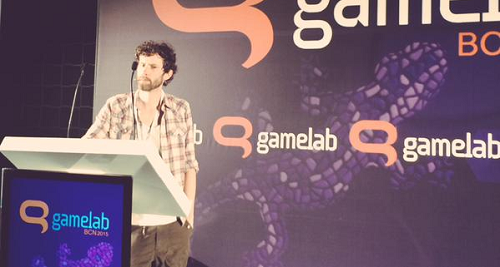
Recently I gave a little talk to games dev audiences at Subotron in Vienna, and Gamelab in Barcelona. The idea of the talk was to first establish some strong design rules I learnt from authors like Terry Pratchett and George Orwell - keep it simple, make it speak - and then to develop a science fiction world using those principles which might form the basis of a future game. As I did this I realised that video games were going to destroy humanity.

For those that requested it, here are the notes and attached powerpoint. For those that didn't request it, feel free to take a look, but note it's probably better live.

As always, feedback, thoughts and counter arguments very welcome.

Wednesday, 30 July 2014

How to Work With a Writer (Or a Guide to Why Your Writer is Sulking)

So the day's finally come. Your studio has been politely informed by the publisher that all successful games have a story written by a dedicated writer now and (perhaps using these tips) you've found yourself one. What now?

Not all jobs start out like this, but it's still common enough for a writer to wind up in a room full of people who have never worked with a writer before, who had no hand in hiring them, and really would quite like to get on with making their game now. I hear you. A writer's job is to understand the project's particular requirements and to support the team (some more from that perspective here).

This being said, there are also some good practices for teams engaging a writer that will make everyone's lives a lot easier. These are, of course, ideals, and subjective ones at that - not every project will be able to support all of them.

This is the guide to how to get the most out of your writer, or how to work out why they're sulking.

Know what scale of narrative your team can support, and be clear about it
Writing is not intrinsically valuable, in the context of game development. Some games are simply better without it, others are better with only a little of it. A small amount of good writing is better than a lot of bad writing. Know what you can support, and make this known to your writer at the outset so they can consider it and plan accordingly.

If you want your game to be 3D and story-driven, both you and your writer are going to have to work a lot harder to implement the narrative than if it's to be 2D and abstract. For the story to work well you need someone at the top who is overseeing every element of the experience - level design, object placement, visuals, voice work, the lot. This is your narrative designer. Now, that person might also be your writer, but they might just as well be your creative director or team lead. What matters is that someone is in that role, because otherwise you're going to end up with a bunch of disjointed elements, an incoherent narrative and a writer in a sulk.

Be aware that story is a two way enterprise
Story is rarely something that can just be bolted on at the last minute to good effect. As much as your writer should come onboard and work towards the framework you have, some give and take will make for a more cohesive product. Yes, your writer could bend over backwards to shape the story to your every specification - but absolute rigidity here due to schedule or budget or whatever is just going to close off fruitful avenues.

Of course, sometimes budget or schedule does force the issue. That's fine, it happens - but in those cases it's extra important that you be clear with your writer from the get go what those restrictions are so they can do their best within them (or flat out turn you down if it's completely bonkers). No one wants a sulking writer.

The more fluid the story development, the better
It's an unfortunate fact that often enough good stories are developed in a quite different order to how many studios order their internal development. In level design, for instance, altering the layout of one level needn't have repercussions for the layout of other areas. You can happily design the big budget levels and art assets , sign off on them, then rehash the intro. 

In story, rehashing one scene can have radical impacts on others. In fact, redrafting is central to producing a strong story. This is the reason that the fear of god will come over your writer when you start talking about building the pivotal scene for your vertical slice, before you finish planning the main plot arch. Any section of the story that's locked down early is like a tetris piece that doesn't dissolve. You can work around it, but that high score will be much further away. For these reasons you'll get the best narrative results when you schedule development in a way that leaves story-sensitive elements as open as possible, for as long as possible. Obviously there is a balance here.

You may also want to ensure that your writer is available throughout development, so that when you make changes to the game design on the fly they can make appropriate updates to the story. Sure, you could just book your writer for two months at the start of the project to write the script and knock it off the list, but this will scare them no end. Things will change during development which will put their writing out of context, and their reputation will depend on whether or not you pick up the phone to have them correct it. Some of the work I'm most proud of has been at the end of a project, where I'm entrenched with a team doing crunch time, keeping pace with their design changes, and developing creative solutions on the fly.

Writers want to collaborate with you, not be used as a service.

Give your writer some space to write
On most of my projects I have had teams who gave me a brief and told me to ask if I needed anything. This is great because it gives me the freedom to experiment with what works, and to spend the time where I think it's needed. On some projects I have been more directly managed, and which works best is really dependent on the nature of the job. On FTL, for instance, where I'm just producing independent text events to populate particular sectors of space, I don't need space to plan or redraft because for once the kinda work I'm doing is well-suited to a factory-line approach. 

On projects where the role is more involved - a full narrative design role - it could be quite restrictive to have someone else decide what you're working on today. Sometimes designing a character will give you ideas for a dialogue scene that you just have to write while it's fresh. Sometimes you won't really know who the characters are until after you've finished the plot. Sometimes you'll just write something bad in order to get to something good. Provided your writer has a good idea of the scope of the project and the writing budget they can use some freedom to best deploy their skill set. You don't need to sit on them to make sure you hit your production deadlines, you just have to be clear with them what you need and when - and a good writer will deliver it.

Header image is from Hitbox Team's narrative design write up, which is itself a wonderful primer for how to make those big, story-driven games we talked about earlier.

You can read more about how to work with writers, including recommended rates, at the Writers' Guild of Great Britain.

Saturday, 20 April 2013

PAX East & GDC 2013 Debrief

So that whole thing happened, and I am still reeling. I've been trying to think of an angle from which to write up the trip, but have failed, so instead you get the pictorial highlights reel. Lucky old you.


This is our hostel in Boston. It doesn't look it but it was quite luxurious. So much more space in US cities. Also full fried breakfast in the price. Lush.


This is our booth. It's got a rather sleeker black vibe going on compared with last year's, and four HD tellies. We were blaring out the trailer on the big screen, but after a while we started hearing the same two lines of dialogue over and over in our dreams and we had to turn the sound down.


Klei Entertainment are awesome. Play Mark of the Ninja and Don't Starve immediately. As Alia (software engineer, above centre) pointed out to me, they're somewhere in between being a small indie and a pro-developer, and that's a theme that continues throughout the conference. So many people from so many different areas of development all with their own ideas about who's doing important work - and me, somewhere bang in the middle.

PAX was fantastic for us. Quite apart from hanging out with excellent indies like Klei, The Men Who Wear Many Hats, and Blendo Games we secured some lovely coverage for The Swapper. Head to Game Informer, IGN or the New York Post for more.

Also massive props to Kelly and Megabooth for everything and being excellent.

So then we hit San Francisco. Neither Olli (Facepalm Games) nor I had full conference tickets, so this was basically the start of our holiday. I immediately went to Golden Gate Park and was attacked by this gopher thing.


The cab back to the conference hall was surreal. My first time out and about in a city I've written for in a game, and here I am sitting in the back of a cab driving through those iconic streets, listening to a game developer conversation that could have been straight out of the game. I was having fun.

The following days involved avoiding the infamously overcrowded / crap GDC parties, hanging in the indie hostel, and seesawing between horrendously overpriced beers and entirely free ones. The indie hostel was an experience in itself - and entire building taken over by everyone from Zachtronics to Vlambeer. Keeping as I do various fingers in various pies, the whole thing was a slightly different world. Olli knows every game and every person in the room. I can't tell the difference between a student and someone putting out a game everyone else in the room evangelises. At the same time, the writers are a few blocks away on the 40th floor of the Marriott hotel drinking $7.50 beers. I'm getting a bit bored of the stale pizza-by-the-slice, so it's nice to have both options available.

We hit the Humble Bundle party that night, which is a most civilised affair in an old mint building. It of course ends with champagne and scotch being snaffled before the free bar closes, but it's a good crowd, and I manage to pin down John Walker and secure Ir/rational investigator a playtest and some coverage.


The next thing that happens are the IGF awards, in which FTL is nominated, which seem to take us all by surprise. I find my way to our table and meet Justin's parents and assorted family - there are only four of us who credited on the game, but from what I understand it's very much a group endeavour. I can't imagine bringing my parents to an awards show, but Justin's dad was in the industry, and they are awesome and well into the swing of things. We win three awards, I get up on stage once, look very nervous and forget to thank my girlfriend, then we eat tacos and go to the Steam party.


The parties later that night are yet more surreal. We go to the Wild Rumpus, and pretty much everyone I've met in the last week is there, and has been watching the awards. The Subset guys aren't really much part of the indie scene - they're out of AAA, they want to keep their team small, and they want to make the games they love. The limelight is perhaps not their territory. Still, for one night we are minor celebrities. It's quite strange.


The following day I lend a hand on the booth, which really just involves shaking peoples' hands and awkwardly taking credit for Justin and Matt's work. Everyone's played the game, so they just want to come over and say thanks. I love the picture above, because Justin (2nd from right) and Matt (3rd from right) are talking to a chap who worked on the old X-Wing vs Tie Fighter games, which are one of the guys' core inspirations. For once on this trip they get to be the ones meeting their industry heroes.

It was a thrill to spend time with Subset, with Facepalm, and with all the other devs I met out there. I really am lucky to work on the fantastic games I have done, and there's nothing like seeing a bunch of other people making fantastic stuff to make you want to go home and do some more of your own.

As ever, I'll keep you posted on that front.

Monday, 8 April 2013

How to Hire a Games Writer

It seems like I've written a bunch of stuff on how to freelance and secure jobs as a writer, but very little about the other side of that equation - how studios can go about finding and selecting writers. If anything it's perhaps the bigger open question of the two.

Writing is still a new and niche enough discipline that a majority of the people who have hired me have been hiring a writer for the very first time - and they sometimes come across me in the most roundabout of ways. So maybe you're a one-man band looking for someone to write some short dialogues; maybe you're a producer on a AAA tasked with finding a narrative designer. Where do you start?


Where to Look for Writers
Most developers probably know and have worked with numerous freelance programmers, artists and musicians - but if you're hiring a writer for the first time, where should you look?

Online Databases
There are a bunch of sites which allow freelancers of all kinds to upload their details for your perusal, like this one. These are often hit and miss - some are out of date, most have no curation, and many still don't have a separate category for writers. Still, they're usually free for everyone, and a LinkedIn search is never a bad idea. You could also check out local writers' guilds, or the IGDA list - but at the end of the day writers have the same problems getting their names in front of you as you do finding theirs because the channels are so niche and distributed.

Recruitment Agencies
Generally recruitment firms aren't setup to deal with contract positions, but they do have large databases, including lots of writers, so it may not hurt to get in touch. There's a cost associated with advertising via a recruitment agency, but you should have the benefit of a wider reach and some degree of curation on the part of the agent. I was actually contacted by Interactive Selection the other week for a full-time position which I seriously considered, and I'd not been on their site in years, so the reach may work for you.

Writers' Agencies
An agent will represent anywhere from a couple to twenty-odd experienced writers - those ont he smaller side are often a small cabal of writers pooling their marketing resources. A good agent will have writers with guaranteed experience on their books, and be able to recommend particular people for particular jobs, provide a team of writers, or give you an opportunity to meet and assess some potentials.

The only agency with which I have any experience - and the only one I'm aware of of its size and experience - is Sidelines. It currently represents 16 writers (myself included), and frankly I was lucky to get in the door with only the Penumbra games when I did, because in their five years' operation the entry requirements have only gotten tougher. An agency will charge a small commission, which generally comes out of the writer's side.

Do Some DIY Headhunting
You might be surprised by how many games are written by freelance writers. While you can rule out a lot of AAA RPGs, games as diverse as Fable, Tomb Raider, Deus Ex and Hitman all involve freelancers one way or another. It can't hurt to get onto MobyGames, find out who did what on a game you reckon, and click through to their bio to see. Any good freelancer should have a few credits to their name and - if they're any kind of marketer - have their details filled out.

Email the IGDA Writers SIG
There are a lot of experienced writers on this list, and there are also also a lot of journalists and students. Treat accordingly.


How to Select a Writer
Once you've got some names in mind, what should you do? First, read this. That'll give you an idea for rates and standard engagements. Next you should get in touch with your shortlist and gauge their interest in the project. If they're game then - unless you've got someone whose previous work you're sure enough of not to bother - I'd suggest constructing and issuing a short writing test. I think out-of-context samples suck (at least watch a video of the game in action), and often enough the samples a writer has to hand will not sell them to their full. Samples tell you what a writer was able to do under different conditions. A bespoke test tells you what they can actually do for your project.

The test should ask the candidate to write according to a brief in keeping with the project, and should test each of the disciplines required for the role (eg dialogue writing, character design, prose, dialogue trees etc). For a short engagement ( less than 10 days), I'd say a few hundred words is reasonable. For a larger project you should probably stretch to a couple of thousand.

There is a general consensus between the agencies and writing guilds that writers should be paid for the time they spend on tests. I suppose there would be. The reality is that we're often not, and personally I will always take the chance to do a test for a game I'm interested in, whether it's paid or not. If you can afford it, or if you're asking for a big chunk of work, or multiple meetings / submissions then we certainly appreciate it. If not then don't let it put you off.

If you're not sure how to go about constructing the test and you don't have another writer on hand to do it for you, either give your candidate what they need to know about the game and let them take the lead (they should be more than capable of doing so) or get in touch with me.

Finally, get experienced second opinions on the tests. If possible meet your candidates in person, or over Skype. Make a call.

That's it. You've got yourself a writer.

Thursday, 31 May 2012

Old Games Journalism & Diablo's Grind Problem

Thinking about some of the backlash around Diablo 3 recently - without having the somewhat masochistic urge to play it myself - some thoughts started to slot together around objectivity in video games criticism, and the ways in which we judge and award certain mechanics.

It seems to me as if, awesome a pursuit though it is, New Games Journalism has not achieved widespread adoption (not that Kieron was necessarily seeking as much). If the emphasis in games criticism were on subjective response then the Gamespots and IGNs of this world would be giving games like Diablo a far broader spectrum of scores that reflect opinions like Walker's, rather than the full house of scores in the 80s and 90s it's currently sporting. No, games criticism tends to make some claim to objectivity.

As long as we're treading this path, objectivity needs some rules, and top amongst them must be that a critic's job is to report the actual quality of the actual game. When he awards a game 90% it's because the game was good. Obvious enough.

In order to do that, reviewers tend to avoid referencing (explicitly or otherwise) anything that isn't common to their audience (or a decent chunk of it). Tractor Sim can't be a great game because I grew up on a farm and found it enticingly authentic. Unless, that is, I run Sim Tractor Fan and can safely assume my audience shares those interests.

Critics also tend not just to report their subjective response; they identify it, analyse it, and report the facts about the game which causally underpin it, so that they can explain to an audience with similar tastes what it is about the game that they will or won't appreciate.

When we consider what it is about a game that contributes to its quality the interesting thing that crops up is that it can't be anything that isn't relatively unique to this game. When the first talkies were made their dialogues were rightly praised for all the obvious reasons. Years later, when almost all films feature speech, it would be ludicrous to praise a film for doing so. This is not, of course, to say that the dialogue contributes nothing to the film.

I'm going to argue that there are techniques in games that are analogous, and there are techniques that are still on the cusp of familiarity. We would no longer praise a game for simply featuring physics; but we're still at a stage where a game's physics may be such a step up that it makes sense to laud them critically. Presumably there will come a time when no more advances can be made in that area.

The techniques I have in mind, though, are exemplified by Diablo 3, but also by a growing number of other titles, not to mention the vast majority of successful Kongregate games. Levelling up, RPG elements, character progression... whatever you want to call the steady grind of selecting and unlocking new toys that's a part of everything from Saints Row to Infinity Blade to Farmville - I'm arguing their critical heyday ought be over.

These systems are powerful models of psychological manipulation. This in itself is no problem - manipulation is what we do in games. But these mechanics are so effective - and hence so widely used - that just like using physics in your game, their critical impact ought to be zero. If this game can be rendered engaging in just this way, what can we really say about Diablo 3 other than that it's the same sort of thing with prettier graphics? What is there in Diablo beyond the grind? Why should this sort of entertainment be identified as anything that's even vaguely unique to a particular game?

Diablo was a great game. It did something other games hadn't done - at least not so well. Diablo 3 doesn't exist in the same environment. The major publications may be tied to an objective way of doing things that promises to tell people how fun they'll find the game rather than how much the reviewer liked it, but that need not mean they must award five stars to any game that entertains regardless of how it does so.

Saturday, 26 May 2012

Games Are Stories: The Final Word?

This post originally published at GAMESbrief.

Nicholas Lovell argued recently that 'games are not stories'. As much as he's obviously after a sound-bite the TV chaps will lap up, he justifies a slightly more considered version of the statement with reference to the (true) fact that story tends to be less important in games than in mediums like film or literature. I think Nicholas overestimates slightly how important story is to those other mediums - surely script in those areas is often just as susceptible to the whims of various directors, editors and actors as it is in our own - but I take the point. A movie, no matter how Hollywood it may be, begins with a script. A game, almost always, begins with gameplay and setting.

That's interesting in itself, though. I've never come onto a job where either of those two were particularly up in the air - it's always a sci-fi mmo, or a desert shooter, or a zombie RPG... The setting, it seems, comes in the same breath as the core gameplay. I'd argue that this suggests an alternative take on games - that, in fact, they revolve centrally around their narrative contexts, that these are chosen to work in harmony with the mechanics and that every scrap of work done after that decision is t its best when it works toward both of those goals.

There is a reason that we play cowboy games, and football games; and not precision clicking tests or abstract tactical challenges. A random coloured shape serves all the mechanical purposes of a heavily armed nazi, but we prefer it when our actions in games carry weight and meaning.

I'm reminded of the various discussions that go on around games being fun vs not-fun. It's supposed by some that games need to break free from being fun in order to be important; to be what games are supposed to be. Others say fun is the whole point of games - why would we want to play anything else? Both sides seem to miss the point - a game needs to be entertaining. Like any other creative medium, if we wanted the bare facts we'd look elsewhere. But fun is just a subset of entertainment; not-fun games canstill be entertaining.

I think when we try to argue whether games are or are not about 'story' we end up talking about writing, and opinion is predictably split. Some love cutscenes, others hate them. That's not one we need to solve. But we should be careful trying to claim that games aren't about story, because without story we'd still be playing stuff that looks and feels like tic-tac-toe.

Monday, 2 April 2012

Why Are Games Devs Comfortable With Clones?

I'm sure we're all familiar with copycat games, particularly on mobile: the Zyngas, the XYZ-villes, the Something-Wars... this isn't developers (or publishers) riffing on an existing genre or drawing inspiration; this is outright theft with little to no attempt made to cover up the fact. This is developers remaking an existing game (one of their own, or someone else's, it doesn't seem to matter) with slightly different graphics and adding an 's' to the end of the name.

Why is this okay in games and nowhere else?

Now, before my agent slaps me silly for openly criticising a huge portion of the game industry let me step back a little. This sort of flagrant copying is not new, is not unique to any one studio or industry, and has strong historical precedent. Aping the work that's come before is a fairly usual interim step in creative development: most writers, for instance, start out drawing rather more clues from their favoured authors than they would be comfortable with later in their careers when they develop a stronger personal voice. Film started out in exactly the same place: early Hollywood was rife with the likes of Ed Wood producing cheap knock offs of more ambitious films to satisfy an audience that, at the time, demanded quantity over quality. Those films helped establish a base standard and allowed producers to develop their skill sets beyond it. Even today you can still find the likes of '29 Days Later' and 'Snakes on a Train' on the budget shelf of certain video shops.

The big difference we need to note is that the likes of Touchstone, Pathe or Universal would never dream, today, of releasing 'Saving Private Brian'. To be seen to do as much would be an incredible embarrassment for all involved; so why do the games industry equivalents fail to bat an eyelid?

It's worth observing, here, that while the rise of iOS and other mobile systems has seen copycat games make a massive resurgence, this is not new ground for our industry. Just like film, we started out in a rather more amateur, less profitable place where games were put in the back pages of computer magazines, and creative ambition was of a far lower priority than bums on seats. Without regulation or any great financial investment we had something very similar to the clone culture that exists for certain indie developers: 'I love this game, so I'm going to remake it'. If when Mario Bros came out everyone had gone to great lengths to avoid producing anything similar it seems reasonable to think we'd be in a less varied, less exciting development environment today.

Perhaps my point here is rather obvious, but I expect the reason a major games publisher is no longer embarrassed to put out a clone (as they may have been ten years ago) is that the rise of casual gaming has rendered doing so a hugely profitable pursuit. iOS has brought so many new consumers to our industry that in some respects we're back to square one: an audience base that demands quantity over quality.

This, surely, will not be the case forever. Games are due a far more torrid gestation than other mediums, and this must be another step in that journey just as unpredictable as the last. I can't say I'm not looking forward to the next jump; but equally I do wonder whether there's an even more profitable middle ground there between building on proven mechanics and creating something with ambition. A Doodlejump that does something Doodlejump didn't do sounds like a winner to me.

Monday, 19 December 2011

CD Projekt & Piracy

This one's probably a bit more business-y than usual, first posted as it was over at GAMESbrief.

CD Projekt's been in the news of late over its judicious mailshotting of thousands of members of the German public with demands for settlements to the tune of €911.80 for alleged copyright infringement of The Witcher 2. You can get the details just about anywhere else: basically having removed DRM from the game post-launch as a move to placate honest customers (and much  inline with the outfit's indie facade), CD Projekt have gotten onboard with a law firm, tracked torrent IPs, and demanded retribution.

Naturally enough there's been a backlash. There are a bunch of tacks here, but the basic thing is this: torrent trolling is bad, innocent people get done. It's true enough. Certainly an IP is not a one hundred percent guarentee you've landed yourself a pirate; certainly there will be innocent people who unthinkingly pay up.

At the same time, though, I want to argue in support of CD Projekt; or at least against those reasons. It seems to me that every game company is put in a position where they have to consider their approach to piracy and how they can profit despite or even because of it. CD Projekt is doing its best in that regard. The people there identified that DRM wasn't working: the games were cracked on release, everyone was complaining, and it was probably costing them more money than it was saving. So they jacked it in.

The company's new approach means legitimate customers can enjoy their game without the hoops. It also allows the company to focus attention on the people they actually want (and are legally entitled) to prosecute. Clearly there will be mistakes (unsecured LANs, false IPs etc); but there always are, and there are always processes in place to handle them. CD Projekt is working according to the law and to the demands of its customers. I think it's marginally better than the previous system.

Now, if that all sounds a bit too square, let me add a caveat. I don't think this is the right way about it. Personally, I don't take issue with the handful of innocent IPs that get lettered, and I don't try to pretend that just because piracy isn't stealing that it isn't illegal. In fact, I wouldn't be at all surprised if a lot of the people complaining along those lines didn't either. What I take issue with is the attempt to secure the rights to our internet activity by the government. I take issue with approaches that try to control or fight the freedom the net grants people, and with piracy moves that try to plug the dam after the town's flooded. And yes, I take issue with someone telling me I can't stream an episode of South Park without getting an angry letter. A lot of people get a lot of crap for free now. Ask the Humble Indie Bundle if that's a problem for their bottom line.

My issue isn't with CD Projekt using the law to their best interest. My issue is with the law that allows it.

Monday, 18 July 2011

Say Hello At Develop

As ever I'll be at Develop Conference again this year. I'll be down from Wednesday evening to Thursday evening, checking out the indie track on the last day, along with all the usual afterparties.

Whether you're a budding games writer, a journo looking for a quote, a potential client or just a long-time lurker I'd love to have a natter - as well as catch up with some old faces. My contact details are here, and the best way to get in touch is via email or on the phone on the day.

We'll also be continuing the fine tradition of the journo/indie doss house at the excellent Grapevine Seafront - if you're at a loss for a bed you could do a lot worse.

See you by the sea.

Wednesday, 11 May 2011

Vapourware? You Decide.

I'm taking a risk on this one. Some time ago, I was contacted by a company and entered into discussion on a project. From the go I thought it was a bit too good to be true, but that's for you to decide. This blog is all about a candid insight into development and my career, and the world's full of fun people like those in this story, so I want to share it.

I'm taking two big risks here. First, I'm going to be publishing the representative (let's call him Jim) of the company in question's correspondance in part. He may not like that. More importantly, it's arguably unprofessional to do so. 

Let me make it clear now that I do not break NDAs. The details shared here are either unrelated to game content or they are very broad descriptions that the developer was happy to provide outside of NDA. I consider my clients' privacy paramount, and though this project didn't get as far as that, I will not be naming any names.

So, first off, Jim's original email. The email contained no restrictions regarding reproduction.

My name is [Jim]; I am the director of [the company]. My team and I have been in production of a demo for a next generation game, unique in style, gameplay and in story. It is not an RPG nor an MMO but something completely different. It has gained great interest inside the industry and has many investors, publishers and other developers very interested. We have sponsorship agreements with [some big companies]. [Some other big companies] are among the many game publishers which have expressed their interest in this project. We have varied talent working on the project, artists from [some very big movie studios].
Immediate alarm bells, right? It's not an RPG nor an MMO? Sounds like it's going to be an MMORPG that never happens. The list of interesated parties is far, far, far too good to be true.
[A guy famous for something really quite dubious] acts as business adviser and takes great interest in the project, helping put together a structured business plan. We have had a $53,000+ sponsorship from [a tools company] this software has greatly increased the productivity of the project.
The demo only has three months left in development. For these last three months we are looking to recruit an extra 20-30 developers for the development team, so we can show off the full potential of this remarkable game.
My suspicion is that the sponsorship may have been in the form of free software, but that's just conjecture.
I'm approaching you, requesting, that you join us for the last three months as a story writer. I have seen your site and believe you are talented. After signing NDA agreements further details on the project can be explained to you. If you do join us, and all goes well, when we move in-house you will be offered a full-time position working with [the company]on the actual game development of 180-220 people (Flights and relocation can be discussed, etc). If you believe it would be too difficult to relocate, but are still willing to help out for these last three months you'll be given a letter of recommendation and compensation for the work you have produced. Also upon joining the demo development team you will be given a share in the company (initially small, but will grow as the company develops).
So, it's free work. It turned out later the share in the company is a legal thing to make the contract more binding.
After this final three months of development I have arranged to visit 13 different game publishers and investors to pitch the demo we have created. Half the games out there started off the same way we have, without you and the other people developing on the demo it would not be possible, I ask only three months (part time) to help out on this revolutionary project. Thank you.

Kind Regards,

[Jim]
A big part of me at this stage wanted (and still wants) to believe him. While it's not true half the commercial games out there start off like this, it is true some brilliant ones have done, and it's people like Jim with a dream and some balls that makes that happen.

I got in touch and we had some lengthy conversations on Skype. He was smooth talker, he really sounded like he knew his stuff: contracts, patents, publishing contacts, a big team... and for a moment he had me going. I will happily work for free on a passionate indie project if it's something really exciting that I can invest in.

Then we got past the NDA and he started describing the game. I wish I could share some of the details, but I'm trying to keep this all legal. Suffice it to say, the first sentence was along the lines of, "Okay, so if you want to call it an MMO or an RPG, you can," and any pushing on my part for solid details rearding mechanics resulted in long winded descriptions of character classes and special abilities.

Then there was the contract. I understand the need for a contract even on amateur stuff because it saves problems when you do go commercial and someone starts claiming they own half your game. This one was different. Jim openly admitted he'd spent most of the budget so far on legal expenses, and it showed. Despite having signed an NDA I was asked to sign the contract before I could take a look an any in-game assets or see detailed design documentation regarding the top secret central mechanic that would prove this game was something new and exciting.

That was the end of the line for me, but not for the story.

The sort of big names he was throwing around as interested publishers, and the sort of people he was approaching to work on the project, it was inevitable someone somwhere would know someone at one of the publishers. That was me. I checked in with someone at what is probably one of the most well known publishers in the industry - a publisher with whom Jim had been discussing financing. They'd never heard of him. Maybe he got lost in the post somewhere.

Last I heard, Jim's three month deadline expired some time ago, and he'd begun approaching universities for volunteer developers.

More than anything, I love Jim's gaul. People with a vision, the ability to bring a team together and to find inventive routes to publishing are what creative industries need. The reason I pursued the project at all was because I'm in love with the idea of this all being genuine and being proved wrong a year from now when Jim's the next big thing and I've soiled my lifetime employment opportunities with a huge new developer.

What these project really need, though, is the ability to develop a realistic and successful project off the back of all that - otherwise you end up here. What do you think?

Monday, 4 April 2011

How to be a Good Freelancer

This post originally went up at GAMESbrief to promote their new freelancer database.

Sorry for the header.

In promotion of his new freelancer database, Nicholas Lovell asked me to share what I know about freelancing for anyone who's maybe looking to make the shift. I've been contracting as a games writer for almost five years, and relying on it as my main source of income for the latter half of that time. Over the years it's more often than not been running a good business - rather than any direct correlation between ability and job offers - that's kept me in work.

Securing Work
- Network. I'm not going to repeat all the usual advice. You know how to network. A lot of the jobs aren't sitting on bulletin boards; they're sitting in the bar waiting for you to buy them a pint and tell them about the fascinating / appalling lecture you've just seen. I'm also going to include obvious stuff here like get your name out there, maintain a professional website, blog etc.

- Research standard industry rates for your services, and be confident pitching them (ideally only once you've seen a full brief for the project). Be prepared to engage in and even encourage negotiation. In my experience many devs don't always bother; whether that's a business etiquette thing or a case of it being easier just to get quotes from a bunch of freelancers and chose the best, I don't know. Either way it's a shame, because very few of us are in this industry to make our millions: usually if someone comes to me with a project I want to work on we're able to find a rate and schedule that keeps everyone happy.

- Always meet face to face as soon as possible. There's no great psychology in observing that people form better connections when they've sat in a room together complaining about the red ring of death for half an hour while the tech department finds a new Xbox.

- Stay in touch. Develop an address book of people who might send work your way (either now or in new roles in the future, ie almost everyone). If you publish a new game, start a relevant new endeavour, or have anything valuable to say, send them a note. I wouldn't do this more than a few times a year, if that - spam is bad - but lots of people will hopefully consider you a genuinely valuable contact, even if they don't necessarily send you a fantastic job immediately.

On the job
- Under promise, over deliver. It's an old freelancer thing, but it'll save you being the dreaded British builder who always winds up charging 100% more than he quoted. Adjust your guarentees against how good you are at estimating workloads. You'll have to use judgement on when a client is looking for a lower quote, but most of the time if you can develop a reputation for delivering on time, and even early, you're golden.

- Find the balance between the client's expectations and your own expertise. What you think the audience wants and what the client thinks don't always coincide. You've been hired to do what you're told, certainly, but you've also been hired to make their game as strong as you possibly can. Learn to let go of the small battles, justify your decisions when you hold your ground, and be prepared to be overruled without losing the smile. You're all on the same team.

Finally, always keep the producer happy. Always, always deliver on time. Stay one step ahead of the needs of the developer. Stay in contact as much as possible. The company hires you because you make life easier: they get to know what they're getting, when they're getting it and how much it's going to cost. You probably cost more than an in-house equivalent would, so you're the one guy who can't get away with deadline slippage. Producers are often overworked. They have a dozen other freelancers like you to manage. If you're the one guy they never have to hassle over a deadline they're going to hire you again.

Monday, 14 March 2011

10 Tips on How to Become a Professional Games Writer

It's the number one question we get asked. We talk about it in panels, in classes, in interviews, and in the pub. Even assuming you're remarkably talented and know everything that's everything about games, you're facing long odds - but you know that already. I don't claim to be any kind of expert at 'getting in' - after all, I've only done it the once - but for what it's worth, here's the definitive guide as I see it to becoming a professional narrative designer.

1. Be a remarkably talented writer. Frankly, like me, you could get away with being competent with a bit of personal flair, provided you also have a bit of luck and know games inside out. But if you're a naff writer - if you've not written for yourself, or braved honest critique with your work - that's your first stumbling block. Being fantastic will help lots.

2. Understand games. Playing lots of shooters probably isn't enough. You've got to think about games critically as any developer would - that's what makes you a narrative designer, not just a hired hack.

3. To those ends, play lots of games, read lots of books. Think about them. Write about them.

4. Keep trying, take anything, try everything. Build an indie game, write for a mod, write reviews, email devs, work in QA, build a portfolio.

5. Network. Doesn't matter what route you come into the business through, getting jobs - particularly writing jobs - isn't always a case of seeing an ad and sending in your CV. Go to events, buy people beer, bum a cigarette, blog, twitter, remind people you exist.

6. Network. Seriously. 70% of my work comes through networking and repeat custom. The rest is through my fabulous agency (who, I'm afraid, only consider established professionals). Can you guess how I got in touch with my fabulous agency? Networking.

The routes in... 
7. Be a professional writer in another medium. Sounds like a big ask, but look at it this way: every medium other than games is better equipped to recognise and reward writing talent. Books and comics in particular are far lower cost, and have more releases every year - and therefore have more demand for good writing. It'll still require excellent networking to make the switch, though.

8. Move roles within the games industry. Entry level positions in production, level design and QA are all realistic goals for a talented writer and, with some careful planning and a constant eye on opportunities within the company, can be converted into a writing role - either over time by picking up basic writing responsibilities, or as a direct move. Do note, though, that telling your seasoned QA manager that you're only there to get a 'proper job' is most likely a poor idea.

9. Get in with the indies. This was my route. Working on something amateur is very easy to get into (by comparison to, say, writing a novel). Do it enough and one of them might turn pro. Congrats - you've got your first professional writing credit! Now go network!

10. Learn from my mistakes.
DO email loads of devs (ideally smaller ones in less established territories like eastern Europe) out of the blue telling them how much you love their games (if you do) and how you think you can help. I must have sent hundreds of prospective mails before I got my break on Penumbra.

DON'T piss people off with spam.

DO keep trying.

DON'T keep trying if everyone (even your mum) tells you your writing is shit. It probably is. Play to your strengths.

DO realise that being a video game writer is one of the most sought after jobs on the planet because it's one of the most amazing jobs on the planet.

DON'T forget that if you're a fantastic writer you're already ahead of 90% of your competition.

***UPDATE 2***
This post remains the most hit page of this blog, so I can only figure a lot of you are landing here from google searches and whatnot. Hello, I'm Tom.

If you'd like more help and resources on how to get into this line of work do leave me a comment down below and I'll get back to you. I also recommend you check out the list of narrative design resources (design docs etc) listed on this very site!

You may also find some of the other posts on this blog of use. Some good places to start are the Development and Advice tags.

***UPDATE***
I went to a BAFTA games writing event recently at the ICA to have a meeting with my agent and Charles Cecil, and met a chap from the drama industry looking to break into games. I wrote him out some good places to start looking for small indie teams and while I'm sure a lot of my readers will be familiar with these already, they may prove useful for anyone referring back here in the future.

http://forums.tigsource.com/index.php Indie dev forums with lots of work-in-progress and volunteer request threads. Just be aware that most are ludicrous pipe dreams; steer clear of the one-man-MMOs.

http://www.gamasutra.com/jobs/ I've seen the odd small / cheap writing job go up on these boards, worth posting a profile at any rate.

http://www.moddb.com/ Home of work-in-progress mod projects, some really good stuff here.

http://www.igf.com/ Competition for the very best indies, should give you a picture of who's big at the mo.

Monday, 7 March 2011

With Fewer Obstacles to Release and Escalating Audience Demand, is PC Gaming Becoming the Realm of the B-Game?

Sometimes I like to wander around Steam looking for some under-marketed, under-reviewed, under-£5 indie gem. Sometimes I find fascinating stuff like Dinner Date or Winter Voices; sometimes it's utter tat; but it's always interesting (and rare) to come to a game with zero preconceptions, and that's not half because a boxed game is usually too expensive to buy without reasonable evidence that you're going to like it.

On my travels recently I've come accross an increasing number of what I'm going to term B-Games. In cinema, the B-Movie was the cheap filler that was produced - often as accompanyment to a more polished feature - to feed the unforseen demand that had appeared overnight. They usually focussed on tick box stuff that could easily be sold: horror, gore, sex, exploitation; and audiences were so hungry for content that they devoured it without complaint.

The idea of a cheap, poorly crafted game is nothing new, but it seems the environment is ripe for a whole new wave. The audience for games today is larger than it has ever been. The games themselves, though, are more expensive to produce and provide ever shorter playtimes. This, I'd argue, is exhasperated by the fact tastes are more niche than they ever have been. There are a greater variety of genres to focus on - many of which are hard to come by these days - and gamers are older and more set in their ways than the fledgling industry could have allowed 20 years ago. Digital distribution, therefore, provides just the low cost delivery platform required in order to produce and distribute a cheap genre game that will - for simply being in that genre - satisfy a profitable portion of the audience.

Look at the games that are able to find their way onto Steam. Dungeons not only makes no qualms about its Bullfrog inspirations, it uses them in its marketing (and though there is gameplay differentiation here, visually speaking 'inspired by' is less fair than ' clone of'). Hacker Evolution's content and minimalist presentation is straight Uplink in a way that's so uncanny any claim of shared inspiration can be safely replaced in favour of canny targeting. Kaptain Brawe is an achievement for looking more like a LucasArts adventure than anything ever made in SCUMM - it's practically postmodern simulacra. Monday Night Combat is hard not to like, but it's plain bizarre to release a $15 budget version of a game that's already only $15.

Analysis? Well, I suppose in the same way that all the talented indie devs who spend their days turning out retro clones is a drive that completely passes me by, the idea here of relegating game design is a touch uncomfortable. B-Movies were cheap, and bad, and mostly better forgotten - sure; but they also pushed boundaries and proved their longevity (through ironic rewatching, historical interest and modern homage) in ways I find it hard to believe games are likely to ape.

It could be argued, though, that what this is all truly indicative of is just how slowly games are developing. At that rate we should hit our Post-Classical era some time around two centuries from now.

Wake me up when we get there.

Saturday, 12 February 2011

The Challenge of AAA Writing, or Why Tom Can't Get No Respect

This is a guest post by Mark Seymour, the top student from the Story Design module I taught at Southbank Uni last year. Here he talks a bit about my classes, a bit about the role of the writer in games, and lots about Dead Space 2 and how narrative design in AAAs isn't all it could be. Read and learn how to complain about everything and still sound like a great guy.

There really is no celebrity game writer culture, is there? No King or Bukowski, no Coen or [David] Simon or even an Alex Garland. It’s not like film or literature where (s)he who holds the pen has the power to draw in an audience based on name alone. I watch a Call of Duty trailer and tick off a mental checklist:

1. Multiplayer
2. Nazis and/or Russians
3. Gratuitous violence
4. NPC with a moustache

And as long as at least two of those are satisfied it’s a preorder and another tropical island paradise for Activision. Show me a trailer for the Transformers movie, though, and I’ll switch off. Story and character are more important than moustaches, AC-130’s and detachable limbs when it comes to cinema but in games it’s usually an afterthought and for the majority of gamers, that doesn’t really matter. Look at World of Warcraft.

Speaking of Alex Garland, by comparative standards Enslaved boasted some of the better AAA writing of last year; its story didn’t feature an awkward sex scene where neither character took their clothes off and at no point did anyone enter monologue and say something like: “I’d have to kill that giant laser-beam vomiting robot by shooting its glowing orange weak spots” ala Alan Wake (how do you go from Max Payne 2 to that?)

But by eschewing dedicated games writers Ninja Theory ensured they had a claim to fame they never could have had by employing an industry specialist. A fame firmly embedded in another medium altogether.

So if there’s one thing I’ve learned from 12 lectures with Tom Jubert it’s that games writers aren’t always on the receiving end of much respect. (Ha, thanks mate, what a legacy that is; knew I shouldn't have told you to write about what you learned - TJ)

In one of the final lectures we listened to a panel of writers recount tales of woe from their own works. Judging by their accounts, both Rhianna Pratchett and Andrew Walsh had a hard time with Mirror’s Edge and the latest Harry Potter game respectively, both having substantial parts of their scripts annihilated without their approval.

Maybe its naivety but I can’t imagine anyone taking Thomas-Anderson’s There Will be Blood script and altering the film’s denouement so Daniel Plainview repents and spends his fortunes helping his disabled son live a better life. People respect his storytelling ability but that doesn’t appear to be the case in the videogame industry. Also, a world without "I drink your milkshake"? Horrid.

That’s not the only thing Tom taught us, and I don’t think he intended to leave that mark, but in the context of story driving gameplay and not the other way around, it seems to me like respect is a hurdle that needs to be conquered.

Lectures weren’t all doom and gloom though. In fact compared to the stress of the 3D level design and 3D character modelling and animation units we studied in tandem with writing, Tom’s lectures were a welcome opportunity to actually talk about some games as well as listen to the writing and ideas others were working on.

Lectures were split into two halves; the first hour dedicated to Tom’s unbridled love of Planescape and the second our own writing. Planescape aside, we studied titles like Bioshock 2 and Everyday the Same Dream to see how they told their stories without employing the conventional cut scene. With our own work – a 3500-word document split between script samples and a general overview - we were encouraged to ditch the tired old cinematic and explore more inventive avenues of storytelling. And it’s not until you sit down and give that a go for yourself that you realise it’s actually damn hard and that the cut scene exists for some very good reasons, not least of all because it’s safe and reliable.

I tried my hand at interactive dialogue, another weary method of storytelling, and while that was a tactical choice to sidestep the cut scene and ensure the man marking my work was slightly appeased, I had a tough time finding ways to tell a story via gameplay and speaking to others on the course, they did to.

It came as no surprise that the indie titles we looked at, by comparison, boasted the lion’s share of the interesting ideas, but having just finished Dead Space 2 there are certainly AAA games with a few ideas of their own. Dead Space takes some of the most artificial game tenets (the HUD and cut scenes predominantly) and ties them neatly into the narrative design. Protagonist Isaac Clarke wears a super high-tech space suit that incorporates the life gauge into its design. When angry Necromorphs begin tearing his kneecaps out of his armpits, the life gauge on his back estimates his chances of survival to an exact measure, all in typical last-generation fashion. The life bar is still a life bar but at least in Dead Space it has been weaved into the lore rather than popping up as an inexplicable red hue around the screen.

Elsewhere, 95% of what could be intrusive cinematics occur with the player in full control and are projected in front of Clarke’s face, again as part of his suit’s repertoire of science-fiction usefulness. By tying mechanics into story, fighting an endless barrage of zombie Mr. Tickles in space becomes a more intense and believable affair, there’s no respite (unless you pause) and without a screen adjourned with endless statistics the world and the horror within takes precedence.

That said Isaac Clarke is still partial to the odd observational comment, the kind of remark that makes you question what the average IQ of people playing videogames is. Thank you for reaffirming the sudden, distinct and total removal of light from the scene, I hadn’t noticed.

Dead Space is far from perfect but the lesson learned from trying to invent creative ways of telling a story is it’s an immensely difficult and risky process and it’s one that doesn’t happen too much.

But as is so often pointed out, this is an industry still riding through relative infancy. The situation now – from the perspective of those who treasure narrative over shooting half Russian half Nazi zombie alien monsters in the face – for the most part is far from idyllic but I’ve come away from these lectures with a little bit of hope that one day, I’ll be able to play a fantastic AAA behemoth title without being reminded of something as glaringly obvious as all the lights going out.

Monday, 29 November 2010

Why Zombies as a Genre Are Here to Stay

I heart zombies. Not just in a geeky, B-movie kind of a way (though props to Zombi 2), and not just from the perspective of a horror video game writer (because I don't really consider myself that) - but mostly because for any kind of writer it's a premise overloaded with potential for character exploration.

Unlike World War 2 or modern combat or comic books or Westerns, Zombie fiction in both cinematic and interactive entertainment is a stayer. This is why.

The image above - beyond any excuse to picture Milla - represents everything that people get wrong about developing a zombie fiction. Sci-fi environs, super ninja bitches, mad scientists... Resident Evil (by turn both the games and the films) misses the point.

I've never particularly had any desire to write horror as a profession. Before the Penumbra games it's not something I'd ever even attempted. It's always been a genre close to my heart, though, for one reason: it puts human nature under the microscope. To some degree, perhaps, that's what all good fiction does. But the reason that stories like Alien, The Thing and Dead Ringers are truly great horrors is that they take real, everyday characters - even when those characters are in fantastic circumstances - and put them under pressure. In GCSE chemistry, if you want to learn about a particular substance you put it to extremes: you heat it, or you cool it, or you spin it around really really really fast until it's all dizzy. Then you wait and see what happens.

Good horror - particularly zombie horror - works the same way. You take ordinary people, expose them to extreme pressure, and see if they wind up killing one another. Alien argues that everyone has different potential: that the cute blonde tomboy hides cowardice that will overrule even self-preservation; and that the hero of the story might actually have tits. The Thing shows us that rational human doubt can overpower anything; even a strong friendship.

Sometimes film - and often games - get this wrong. Games are great at developing tension and fear. Better, I'd argue, than any other medium. But how often does a zombie game use this to explore themes within its characters? We all know Dead State is heading in the right direction, and we're probably familiar with Dead Rising's blatant Romero-esque critique of consumerism, but how often do we go beyond that?

As a genre, zombies have only been around for a few decades. The concept originated with Voodoo-related catatonia, and Romero and his ilk imported it to Hollywood in the 60s. This means that the five year fad that began with Stubbs the Zombie and L4D (a game which captures the rumour mill and camaraderie, but none of the suspicion or character progression) really marks the first time that zombies have truly been road-tested on an interactive level. What zombies allow us to do as writers is to introduce a whole host of useful mechanics - mechanics zombie games often exclude - and to have these feedback in unique ways on the story:
- Where did the outbreak come from (room for government conspiracy and social critique)?
- What do you do when you / someone else gets infected?
- How do you treat other survivors when they might be your best survival tool or your greatest threat?
- What happens to morality in a world where violence is around every corner?
- How quickly and in what ways do society's rules break down?
- What is there to pursue beyond survival in a world beyond the brink of revival?
- What rights do the zombies themselves have?
- Without a social structure to tell you what to do, what happens when people have to think for themselves for the first time in their lives?
- Where is your god now?
- Is a katana really the best weapon?

Zombies are uniquely interesting for precisely these topics. You'd be hard pressed to find a good Z fiction that didn't centre on at least one of these ideas.

As both a writer and a consumer, I'm fascinated more than anything else by humanity and by honest (even when scary) appraisals of it. I'd argue that zombie games provide us that opportunity and much more beside; any time someone says to me that zombies are just the latest fad, I figure they've been playing too much Resident Evil.

Unlike WW2, or Tolkien, or Vietnam, zombies always have new places to go; but what they tell us about ourselves should always be a little too close to home.

Friday, 12 November 2010

London Writing Panel Appearence: Interactive Story Telling for an Interactive Medium

The IGDA has just announced a new games writing panel that's going to be held in London the week after next. It's going to star some of my big name games writing mates and - less spectacularly - me. Official blurb at the bottom of the post, my unofficial blurb immediately below.

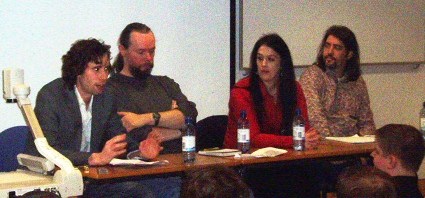
Environmental Narrative: Interactive Storytelling for an Interactive Medium is kind of a sequel to a talk we - Jim Swallow (Deux Ex 3), Rhianna Pratchett (Overlord), Andy Walsh (Prince of Persia) and I - turned out last year. Despite the atrocious press photo from the event that's the header for this post (I'm the one with the terrible hair and evil eyes yammering away while everyone else stops and stares in disbelief), the thing went well, and we're back. It was rammed last time around - a mixed audience of games students, professional writers from other mediums, and developers in other disciplines - and I'd argue the pub trip afterwards is a great networking opportunity.

It's being held the evening of 23rd November at London South Bank University. Incidentally, it was this event last year that brought me to the attention of the Game Cultures BA guys at LSBU and landed me my current lecturing job.

Hope you're able to make it, and if you are rocking up do drop me a note beforehand and come grab me in the pub - be good to put some faces to some names.

-----------------------------------------------------

http://www.facebook.com/event.php?eid=166138263406405

Time: 23 November · 19:00 - 21:00
Location: Keyworth Theatre B, Keyworth Building, London South Bank University
Keyworth Street (http://www.lsbu.ac.uk/about/maps.shtml) easiest tube is elephant and castle. Take South Bank University exit
London, United Kingdom

Environmental Narrative: Interactive Story Telling for an Interactive Medium
Hosted by LSBU's BA (Hons) Game Cultures course

Following last year's packed event, the IGDA London Chapter and IGDA's Writing SIG will be presenting a talk at London South Bank University on the evening of Tuesday 23rd November. A panel composed of well-established videogames experts will be focusing on how AI and environment can tell story in games.

Entry will be free and the panel will be followed by both a formal Q&A session and an informal trip to the pub. We hope you can join us.

The panel will be comprised of experienced games writers -

Tom Jubert (Driver: San Francisco , The Penumbra series)
Rhianna Pratchett (Overlord, Heavenly Sword)
James Swallow (Deus Ex Human Revolution, Battlestar Galactica)
Andrew S. Walsh (Bodycount, Prince of Persia )

Thursday, 14 October 2010

GAMESbrief Guest Post: The Ship Dev, Outerlight, Dead in the Water

The guys who made Agatha Christie simulators The Ship and upcoming Bloody Good Time (a game I was actually excited about) have all but gone under.

Bad ship-related puns aside it's real sad news. Chris Peck, co-founder of Outerlight, is the last man standing, and he's spoken very candidly about how big publishing is antithesis to innovation, and how the true home in the future for people-who-like-more-than-just-blowing-shit-up (ie us) is in digital distribution - if you can magic the financing.

Full thing over at GAMESbrief.

Wednesday, 28 July 2010

The Hollywood Model of Employment & Individual Culpability


The recent consideration I've been giving to the projects I've worked on and my role within them has encouraged a regular topic of discussion between myself and GAMESbrief's Nicholas Lovell to resurface in my thoughts: that is, the idea that the current model of permanent 100+ man teams is dead, and that video games as a medium should be moving towards the project-by-project freelancing approach of the film industry.

The arguments in favour of such an approach are plenty:

1. Eliminate costs associated with employee downtime between projects
2. Eliminate post-project redundancies, rendering both staff and the PR department significantly less grumpy
3. Hire a bespoke team suited to each project and scale it up and down as the schedule dictates
4. Reward talent by pursuing those with proven credentials, and don't get lumped with salaried dead weight
5. Freedom for everyone to work on more varied projects
6. A possible compromise for unpaid overtime (ie higher day rates and time off between projects)

The ideal system would be for publishers and/or developers to maintain a small core staff. A group of 1 - 20 trusted, talented individuals (perhaps with a leaning towards production experience), ensuring the studio always has permanent personnel who are invested in the company and can ensure external hires work to the standard required.

Following this, if the studio already has a concept or property, the appropriate hires can be made. "We think cell-shading is the way to go, let's have a chat with the art directors from Mad World, Wind Waker and XIII." Alternatively, the Hollywood model allows for greater autonomy on the part of experienced staff. While talent agents for such trailblazers are already starting to pop up, a more industry wide adoption of this approach might empower - for instance - a talented programmer to approach a publisher with an astonishing concept for a new AI routine, and for that publisher to finance his personal research with a view to providing a growing team as and when the routine has been proven and a game is ready to be built around it. On a more obvious level, a designer and a writer could pitch a project to a studio in just the same way as a director might approach Pathé with a screenplay.

Culpability
One of the main draws of this system for an individual developer might be increased public and industry recognition of his or her talent. In the next month or two there are two games coming out that I'm connected to: Lost Horizon and Amnesia. What's strange about these games is that on one my name will be in the credits as the writer - despite the original script being by someone else - while on the other a great many people will assume I was the writer when in fact I haven't been involved.

When Amnesia arrives, it's going to be an interesting experience discovering what a Penumbra game looks like with someone else behind the keyboard. Naturally I'm a part of this industry because I want to be involved in developing fantastic, important games; but at the same time there are few creatives who could honestly claim they don't hope for some kind of artistic identity in their work, some stamp of their involvement. If Amnesia arrives to rave reviews it's only right that Mikael Hedberg should take credit; if things don't go so well it'll be disheartening that very few players or critics will realise why. Full credit to journos like Lewis Denby - who do their research and credit appropriately in their articles - but while it's very common to read something like, "Mauro Fiore's cinematography in Avatar is his best work to date," in a film review, it's incredibly rare in games.

In Lost Horizon, while I hope I've added a distinctive flavour of my own, the script is ultimately originated by another writer. While I was involved in the voice direction, I wasn't sitting in the chair, and I had no say over casting. If and when Lost Horizon receives praise, it's right that I should take only partial responsibility - but it's incredibly difficult to ascertain who's culpable for what.

My dream is of a model where key talent (department leads etc) are recognised for their triumphs and successes by the press, the audience, and by the industry. While most developers remain salaried their studios will remain cautious of talent poaching, but with an employment reform developers would be free to deliver, along with review code, a short document highlighting the central talent and their roles, so that critics can credit appropriately.

There are arguments against, of course. Speaking with Craig Pearson of PCG UK, he pointed out the potential damage a bad review under this system could do to a career. It's the problem games writers complain of non-stop: that good writing implemented badly reflects badly on the writer through no fault of their own. There's also the question of who deserves this elite status as a front of the box credit.

There's no denying these are problems, but they're problems every other industry seems to handle, and I believe the benefits outweigh the drawbacks. I dream of the day when someone plays a game and says, "Well, I can see elements of what Brian Mitsoda brought to the latter stages of Neverwinter Nights 2, but it's clear his style is more coherently implemented in Vampire: Bloodlines, and this game continues that confidence of expression."

Hey: a man can dream, can't he?

Update 29/07/10: Brian Mitsoda writes a friendly hello and suggests one possible drawback of the Hollywood model is typecasting of freelancers as developers rely more and more on their previous work to secure new jobs. He also points out that, contrary to what's suggested above, of all the very talented people on NWN2 he wasn't actually one of them. My fault.