Showing posts with label massive love. Show all posts

Thursday, 7 December 2023

2023 Update


It has been a long time.

Life is wild.

I'll limit this post to factual updates.

Talos 2 did great critically and I fear abysmally commercially. I'm so proud of Jonas, Verena, Hunski, Tome, Kuber, Goran, Damjan and everyone else and especially Moss. And I'm glad I did what I did (a subplot probably <1% of the total word count); and a bit sorry I didn't do more. Some people vibed with my stuff, and some people recognised it was underdeveloped. I'm sure some did both (I certainly did).

The team are working on small DLCs. I would like to add some new 'Internal Monolog' character to those, but I am not sure whether Jonas will find a space for me to do it. If not then I hope Devolver will not go under and we will make Talos 3.

A couple years ago I took a job I shouldn't have because it's too big and long for me, but it's a really cool RPG world that I want to stretch my legs in before I go back to smaller things. Hopefully we announce next year.

Besides that I seriously hope Inner Party - the indie studio I co-founded with Jonas Boetel (Subnautica programmer) and Warby (brilliant technical artist) will get off the ground. Either they will find a prototype that sells and I'll add writing; or I'll finish this RPG and we'll do it together. Making games with those guys is my absolute number one dream.

I continue to take my twitter to ever more performative heights. I am glad to have the professional freedom to print whatever wild experimental ideas I like on there and still have a job afterwards. Although it does start to blur the line between created-character and self-identity. I'd rather keep the two entirely separate, or totally entwined. We're all characters, after all.

I have spent a good deal of the last two years going down rabbit holes. Morality, de facto power, global dynamics, honesty vs utility, non-human intelligence and AGI, faith and the occult, god and the devil. Interesting stuff to me right now. The challenge is balancing research with production.

I am also stepping into very new phases in my personal life. But that is not to be factually stated, instead it'll be there codified in everything I do.

Life is very strange. I find big parts of it change a lot - and big parts stay the same. Increasingly I understand what's going on, but not exactly in what way.

I started this blog and this career inspired by the writers who bared their souls so that I could learn from them. Increasingly I wish I could undergo my personal changes without their being public - but I am too lazy to start my career again from scratch as an anon, and too in need of purpose not to share my experience at all. Still, like a politician caught on hotmike saying what they really think, I'm aware from the outside it might seem terribly inconsistent.

Cliche I know, but for good reason: if my words can help just one person as others' words have helped me then all is well in my world.

And remember...

Saturday, 25 October 2014

Talos Principle Coming Soon (+ Games You Can Play Now)

Okay, congratulations me for failing to write anything here for ages. The reason I will give for this is that I am somewhat Autistic-spectrum inclined and I only have enough room in my brain for one obsession at a time.

Nevertheless I shall endeavour to formulate some form of update. 

The Talos Principle is almost done. The guys in Zagreb are applying final polish, and next week we complete the voice work. Sigils of Elohim, the Tetris-like minigame we're dishing out free, is out now. In case you're not familiar with the game, it's a first-person philosophical puzzler, set in a synthetic world. Or, as I've been selling it to my non-gamer mates, a game where you get to argue with the devil.

This is usually the part where I put my money where my mouth is and try to predict how the game will be received. I'm happy to say that, like The Swapper, Talos is at the very least a sound puzzle game. I'm not worried about scoring sub-70s. Beyond that, well, I'd say this is a looser game than The Swapper - it's a much bigger world, so that's only natural - but it also does something that none of my previous games have: it lets me write an involved interactive dialogue. It is my great hope that that dialogue will excite people. It is, I think, fairly unique.

A 2014 release date should be confirmed very shortly, and it'll release on Win, Mac, Linux, PS4 and Shield Tablets.

In other news, my brain has mostly been consumed with political philosophical research.

I have gone through a bit of a journey over the past ten years: from not really thinking about anything very much, to realising that and embracing philosophy. I searched frantically during my BA for solid ground on which to base my moral assumptions, and found none. Perversely this left me right back where I started: an individualist, who recognises that the system we live in is broken and resolves to do everything in their power to get the better of it.

Now I'm not ready to say yet that my ethical outlook has changed. I am still dubious of absolute moral systems, dubious of anyone who claims there is some authority outside of ourselves. What's changed is that I'm now better aware of the broader picture, politically and (most importantly) historically. I never understood the value of history in school; now I understand perfectly that history provides us an irreplaceable point of reference for how human existence can be - it enables us to identify the assumptions, the invisible shackles, that underpin our way of life today.

Supposing there is no absolute morality, the need for a sound political framework becomes even more pronounced. We are all, more or less, rational animals. It may only be our own sense of reason that provides authority to claims about how we should behave, but that needn't mean the output is any less authoritative.

So my next project is going to be aimed at replicating this journey on a massive scale. I want to pull our perspective out from the subjective, close-up one we take in every day life, and show how our political society is shaped by usually invisible forces on this grand scale. I want to explore what happens when we are all individualists and consumers who give in to these forces. And I want to construct a framework for how individualists might nonetheless find value in working towards a fairer society. And that is what I have mostly been thinking about.

Now, to lighten the mood, some excellent games I played recently.

The Escapists - Excellent isometric prison-break sim in Early Access. Plays like a minimalist, freeform Prisoner of War. Keep up appearances by attending exercise, rolecall and jobs; while simultaneously preparing for your escape by gathering weapons, digging tunnels, forging alliances, stealing uniforms etc.

Invisible Inc. - I was always going to love this one. The new isometric, turn-based stealth game from Klei, it boasts their usual high level of support, and I think is now my favourite of their releases.

The Vanishing of Ethan Carter - A lot of positive things already said about this one, but they're worth re-enforcing. It's a uniquely beautiful world, not only for the fidelity of the graphics, but the architectural design itself. The plot is shamelessly pulp fiction, and somewhat predictable for it; but the real narrative punch is delivered by the mechanics themselves and the inventive ends to which they're put. This game takes you on a journey like no other.

Wednesday, 3 July 2013

Free Indie Game: Outer Wilds


Don't look at the trailer. Don't read this. Play (at as high a resolution as you can manage). It only takes 20 minutes. Then explore some more, and come back when you're done.

Monday, 24 June 2013

The Games You Must Have Played in 2012/13 - Part 2

Part 1 here.

Mark of the Ninja
Another Klei title? Definitely. Mark the Ninja, as he is called by sensible people, has an excellent stealth game built around him. While we seem to be rather spoilt for indie stealth titles at the moment (Monaco, Gunpoint, The Swindle...), Mark stands out for being a purer implementation of the ideal, for being rather more substantial in terms of content, and for actually being released. There's also a story packed in there with a fun twist, though it's perhaps not what you'll really be savouring.


Also ninjas.

Also I was reminded in San Francisco that Klei started out with Eets, which I recall from a long lost era when indie games weren't so much of a thing, and which I'm told was the first indie game ever on Steam, which is pretty weird to think about.

Monaco
I really wasn't sure I was going to like Monaco. A quick play at PAX last year only exposed me to the quick-fire chaos of a noob game, and I didn't want arcade, I wanted stealth. Turns out it's my favourite game of the year so far.


The devs are right when they say whatever game you want from Monaco is in there somewhere. Soloing each level, taking it slow and methodical, is possible and highly rewarding, but playing with a reasonably experienced team is even more so. It's amazing how quickly you get comfortable enough with the mechanics to start improvising on the move.

Monaco is a brilliant co-operative stealth game that is worth every single penny, and that's all I'm going to say about it. Oh, and the map editor is coming out soon, apparently, out now in beta, and I am excited. have made a level.

The Walking Dead
And finally, because I'm super lazy and want to go play Don't Starve / read about political justifications for environmentalism / have a smoke / write a Swapper post-mortem... I will simply say: play The Walking Dead. It is amazing, there is new DLC coming out, and I will be surprised if it doesn't take the Writers' Guild of Great Britain Award this year. Oh, and the first episode is free on iPad. Boom.


Tuesday, 11 June 2013

The Games You Must Have Played 2012/13 - Part 1 of 2

There was a time on this blog when I did previews and recommended games and things, and that time is returning... NOW! I've been stuck in exams and The Swapper crunch for the last month or three, but no longer.

Every week I play games that are worth writing about. I rarely actually write because the internet is full of such things, and actually lists are a bit time consuming to write; but it is worth doing if even one person comes here and is sold on a game they'd not gotten around to yet, so here we go. These are the games that stirred that childhood emotion inside me of wonder and delight over the last year.

XCOM: Enemy Unknown
My word does XCOM make me realise how much TBS fans have been hard done by over the past decade, and how glad I am those days are over. Frozen Synapse reinvigorated my interest in the genre, and games like Memoir '44, Hero Academy and Rad Soldiers have been sustaining it. XCOM well and truly sates it.


It's hard not to admit that a big part of XCOM's appeal is in the looks (especially with the HD mods). The cover system is similar in function to Rad Soldiers' (though far more nuanced than), but seeing your people actually dashing for cover in roadie-cam, being pinned down by suppressing fire and shying away from incoming fire actually makes me feel like a commander. Sure the animation and clipping is still seriously rough really quite frequently, but who cares?

The meta-game deserves mention as well. While it's not as involved as the classics, it does a decent enough job of representing to you the global view, and the dramatic progress that you're making. I love the X-Com experience more than anything because it's holistic: I don't feel like I'm playing a game, I feel like I'm defending the world from aliens.

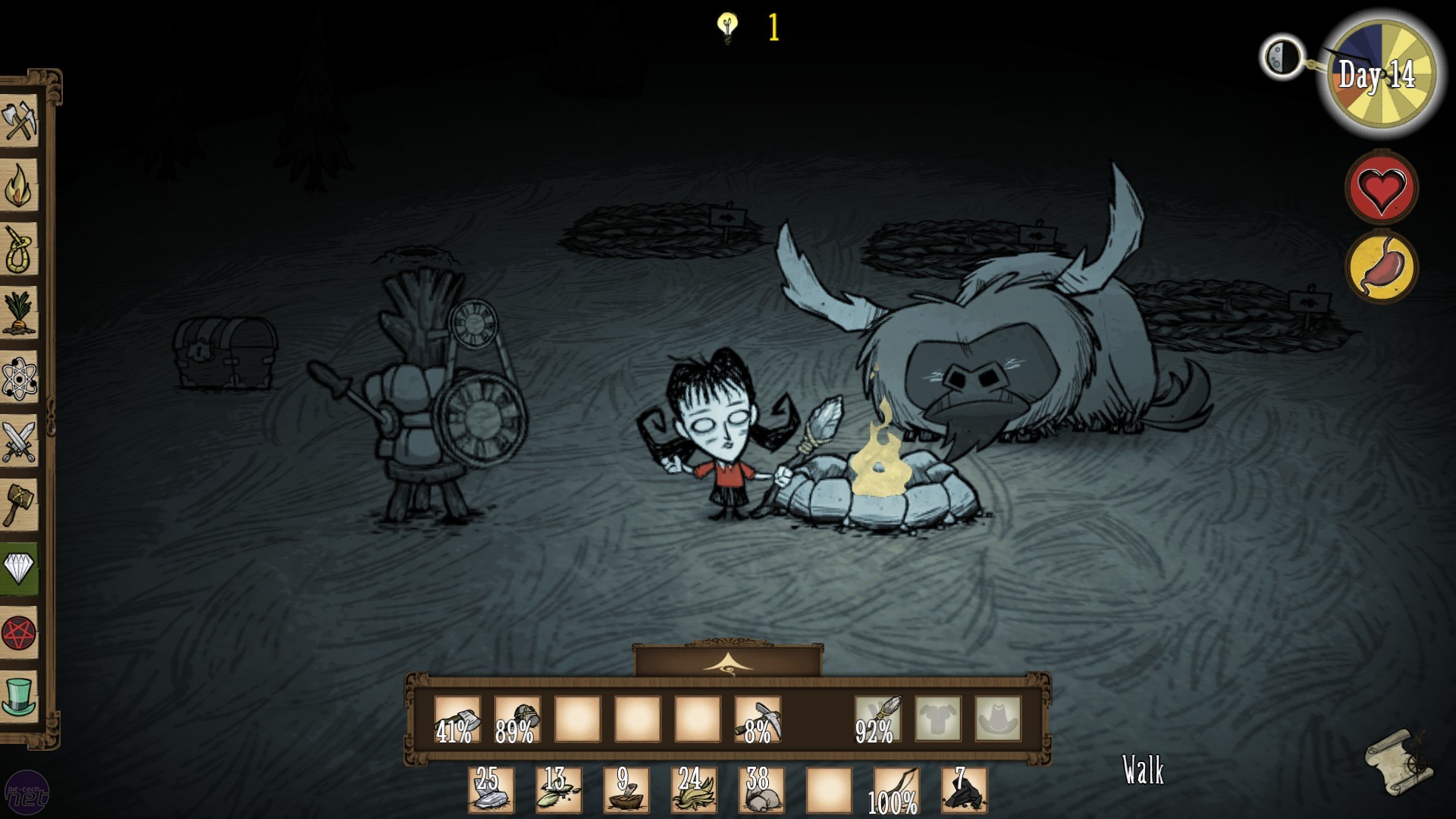
Don't Starve
If I'm honest, I've not booted Don't Starve since it officially released. It hit that point for me where I hadn't played in a while, and I couldn't bring myself to make the reinvestment in the perma-death only to starve gruesomely yet again. Don't Starve, it's true, has a bunch of features that distance me from it. There's not enough hand-holding for me - I like feedback from a game that I'm doing something significant, even if it's only a few lines of text. There's a bit of grind in the Minecraft-y elements as well, and frankly clicking on tiles all day so I can make my garden more aesthetically pleasing isn't the sort of activity I'm ever likely to engage in voluntarily.


None of this is to say I didn't thoroughly enjoy the hours I put in during the beta. I love Don't Starve because it's one of the best survival games I've played. I love dynamic systems, I love fleshed out worlds, and Don't Starve's nightmare wilderness is at once fascinating, fluid and convincing.

Journey
Quite apart from its lovely aesthetic, Journey was an important game for me for its 'co-op'. By eliminating almost all interaction, and then placing players in that beautiful, ever shifting desert Journey achieves that most difficult of goals: it takes the general awfulness of people on the internet and turns it into something wonderful. Okay, perhaps the way I've described this makes Journey a sort of lobotomy: take all the tools away from people and they've got no choice but to be nice; but play through the game to the end with someone you'll never know and tell me you didn't appreciate it.


Part 2 next week.

Saturday, 20 April 2013

PAX East & GDC 2013 Debrief

So that whole thing happened, and I am still reeling. I've been trying to think of an angle from which to write up the trip, but have failed, so instead you get the pictorial highlights reel. Lucky old you.


This is our hostel in Boston. It doesn't look it but it was quite luxurious. So much more space in US cities. Also full fried breakfast in the price. Lush.


This is our booth. It's got a rather sleeker black vibe going on compared with last year's, and four HD tellies. We were blaring out the trailer on the big screen, but after a while we started hearing the same two lines of dialogue over and over in our dreams and we had to turn the sound down.


Klei Entertainment are awesome. Play Mark of the Ninja and Don't Starve immediately. As Alia (software engineer, above centre) pointed out to me, they're somewhere in between being a small indie and a pro-developer, and that's a theme that continues throughout the conference. So many people from so many different areas of development all with their own ideas about who's doing important work - and me, somewhere bang in the middle.

PAX was fantastic for us. Quite apart from hanging out with excellent indies like Klei, The Men Who Wear Many Hats, and Blendo Games we secured some lovely coverage for The Swapper. Head to Game Informer, IGN or the New York Post for more.

Also massive props to Kelly and Megabooth for everything and being excellent.

So then we hit San Francisco. Neither Olli (Facepalm Games) nor I had full conference tickets, so this was basically the start of our holiday. I immediately went to Golden Gate Park and was attacked by this gopher thing.


The cab back to the conference hall was surreal. My first time out and about in a city I've written for in a game, and here I am sitting in the back of a cab driving through those iconic streets, listening to a game developer conversation that could have been straight out of the game. I was having fun.

The following days involved avoiding the infamously overcrowded / crap GDC parties, hanging in the indie hostel, and seesawing between horrendously overpriced beers and entirely free ones. The indie hostel was an experience in itself - and entire building taken over by everyone from Zachtronics to Vlambeer. Keeping as I do various fingers in various pies, the whole thing was a slightly different world. Olli knows every game and every person in the room. I can't tell the difference between a student and someone putting out a game everyone else in the room evangelises. At the same time, the writers are a few blocks away on the 40th floor of the Marriott hotel drinking $7.50 beers. I'm getting a bit bored of the stale pizza-by-the-slice, so it's nice to have both options available.

We hit the Humble Bundle party that night, which is a most civilised affair in an old mint building. It of course ends with champagne and scotch being snaffled before the free bar closes, but it's a good crowd, and I manage to pin down John Walker and secure Ir/rational investigator a playtest and some coverage.


The next thing that happens are the IGF awards, in which FTL is nominated, which seem to take us all by surprise. I find my way to our table and meet Justin's parents and assorted family - there are only four of us who credited on the game, but from what I understand it's very much a group endeavour. I can't imagine bringing my parents to an awards show, but Justin's dad was in the industry, and they are awesome and well into the swing of things. We win three awards, I get up on stage once, look very nervous and forget to thank my girlfriend, then we eat tacos and go to the Steam party.


The parties later that night are yet more surreal. We go to the Wild Rumpus, and pretty much everyone I've met in the last week is there, and has been watching the awards. The Subset guys aren't really much part of the indie scene - they're out of AAA, they want to keep their team small, and they want to make the games they love. The limelight is perhaps not their territory. Still, for one night we are minor celebrities. It's quite strange.


The following day I lend a hand on the booth, which really just involves shaking peoples' hands and awkwardly taking credit for Justin and Matt's work. Everyone's played the game, so they just want to come over and say thanks. I love the picture above, because Justin (2nd from right) and Matt (3rd from right) are talking to a chap who worked on the old X-Wing vs Tie Fighter games, which are one of the guys' core inspirations. For once on this trip they get to be the ones meeting their industry heroes.

It was a thrill to spend time with Subset, with Facepalm, and with all the other devs I met out there. I really am lucky to work on the fantastic games I have done, and there's nothing like seeing a bunch of other people making fantastic stuff to make you want to go home and do some more of your own.

As ever, I'll keep you posted on that front.

Tuesday, 9 October 2012

Interview: Blendo Games on Quadrilateral Cowboy

Brendon Chung of Blendo Games has been responsible for some of the smartest, most varied and distinct indie games of the last few years, including Gravity Bone, Flotilla, Atom Zombie Smasher and Thirty Flights of Loving. I caught up with Brendon at PAX last month where he was exhibiting his new game, Quadrilateral Cowboy.

So, to start us off, tell us a little about your new game.

Sure. It's a cyber-punk 20th century 1980s low-tech hacking game.

Excellent. I've played it, I love it, it's I think my favourite game here. So your games, more than most, are incredibly varied. You've done a turn-based space sim, a zombie strategy game, more surreal things... and now you're doing a first-person stealth hack'em up. Is that a conscious decision on your part to try to nail as many genres as you can, or is it just the way it happens?

I'm not trying to nail as many genres as I can, it's more me trying to get out of my comfort zone. I'm a big fan of when people get out of their comfort zone and do something they're not used to doing. I love seeing when dramatic actors do comedies, I love seeing when comedians do dramatic roles. So for me, that's why. Flotilla was my first turn-based strategy game. I thought - I might as well give it a shot, see what happens.

So there's a theme across a number of your games and it's certainly got a surreal feel to it. How much of that is because you want to have control of your world, how much of that is to give you leeway in the gameplay, is it your style, is it just the way it comes out - tell us what goes on behind that.

So these are just things that I'm interested in like when I read books or watch movies... Woody Allen or the Coen brothers, they influence me a lot in that they have these worlds that are real, but at the same time be wildly fantastic about them.

OK. We talked yesterday about the writing. You said you wanted to keep the text in the new game minimal if even non-existent outside of the computer terminal system that you use; but I got the impression that you like to write, even if you like to keep it out of the games. Tell us a bit about your relationship with the writing.

Yeah, so I love reading, I was a film major in college and writing was one of the things I most enjoyed doing. But then when I play video games I am the type of player that skips past all the text bubbles and cutscenes because if I want to read a good story I will pick up a good book. So I feel like games are best served when  you're interacting with them, not reading pages of text. Although I will say, Planescape: Torment - best game ever made.

I love in that game because they didn't have that detailed animation it was prose, right? You know, "So and so looks at you with a steely gaze and says...". Seems very strange nowadays. So playing Cowboy, you've obviously got a world that functions according to a set of rules, and I love that because it makes the world feel more thorough. It feels real because everything functions independently, you put some stuff int he level and then it goes off and does its stuff, just like in the real world. How do you go about conceptualising that world and what do you think the game rules bring to the game? 

Thirty Flights of Loving and Gravity Bone are very narrative based, very experimental in terms of story. This one's the opposite of that. It's about really high player agency, letting the player run around a simulated cyber-punk world. I was kind of inspired by... Recently I've been a simulation kid. Games I've really liked have been Day Z, Dwarf Fortress, and those are games where it's just pure simulation and they let people be creative within them. That's something I want to support.

I went to the Erik Wolpaw and Tim Schafer talk earlier today about gameplay vs story and someone asked Tim, "How do you feel about games that express their meaning through mechanics rather than pre-authored script?" and he was kind of quite dismissive about it.

In what way?

Something like: "When I interact with a piece of art I feel like I'm communicating with another person, and if all I have is a bunch of mechanics and no pre-authored story then there's no communication." It sounds like you're saying the opposite and I think I'd probably be on your side. Um... that's not really a question...

*Laughs* Yeah, what games I feel excel in is interactivity, and being able to crunch a billion numbers behind the scenes. So an authored story is a form a lot of media can do, but player generated stuff - that's what's so unique to video games. 

Well done, it's almost like I fed you that. One more question . Stealth. I love it, I think you must enjoy it.

Thief is my favourite game of all time. Next to X-Com.

Why?

I like that it makes you roleplay a certain type of character. I think a lot of games now you're some muscle-bound guy and have 20 guns strapped to your back and that's fun, I enjoy that. but I like having variety in my gameplay, so when I played Thief I suddenly played this guy who had one hit point and a guard just looked at me the wrong way and I would drop dead. I'm hiding in a corner and I'm breathing shallowly and hoping he doesn't see me. There's something wonderful about that experience.

Good answer. Brendon, thank you.

You can keep up with Blendo here, and Quadrilateral Cowboy right here.

Tuesday, 5 June 2012

Incoming Transmission


You arrive at the beacon; the shattered hull of an alien ship floats peacefully in the shifting tides of a nearby asteroid field, being drawn inexorably toward the sun at the heart of the system. Nothing else happens.

Then, a distant blip on the scanners that keeps on expanding. It grows closer, larger, until it has enveloped the entire system. The ship is rocked by a shockwave, but the shields hold. You check your star charts - everything has changed. Your journey has become longer and harder, carrying you through uncharted systems and alien empires you've never set eyes on before.

You power the jump drive. This is going to be fun.

Saturday, 24 September 2011

Ride the Wild Rumpus!

New London indie party game night, Wild Rumpus, is just what we need.

Gaming isn't cool. I'm as surprised as you are. Even the name, 'gaming' - sounds kinda seedy, no? Almost like the games are playing us. Sad fact is that the games we really hold up as meaningful still carry teenage baggage (yes, Planescape tells a smart, inventive and evocative story; yes the girls mostly still have big tits and can be talked into bed after you've slain a few hundred goblins), and our mode of enjoyment still tends to be cooped up in a bedroom or lounge, alone, giggling to ourselves. We don't have the same mass participation and discussion that cinema promotes, or the same celebrity culture that marks the upper echelons of literature and drama. Hell, I went to watch a girlfriend at a L'Oreal hair colouring (not dressing, colouring) competition half a decade ago and I remember sitting in the audience watching all these passionate people and wondering how haircolouring could be cooler than the newest artistic medium on the block.

Before you say it, I know we have equivalent stuff. Starcraft tournaments, this week's Eurogamer Expo etc. But they're just not cool. I wouldn't do that on a night out. Sorry.

The Wild Rumpus is cool. Not cool in an exclusive way, but cool in a cool way, in the universal way.


The debut night consisted of one of my fave Brick lane bars filled with indie party games and music and a mix of local devs, gamers and lost ravers from the gig next door. Game of the night was undoubtedly Johann Sebatian Joust, a Playstation Move game that doesn't use a display at all, and asks players to keep their controllers still while jabbing and pushing their opponents. It's all supposed to be timed to the Bach music in the background, though that was way drowned out by the party. Anyway, I'd be surprised if they couldn't box this one as a standalone party game for £40.


It was excellent. The night is run (I found out by chance on the night - see, no bias) by my mate Ricky and his chums, and apparently the best way to keep up is on twitter. The next night is up in Nottingham next month, and they'll doubtless by back to East London shortly after that.

Oh, also, 2-player Super Crate Box in an arcade cabinet.

All photos copyright Natalie Seery

Wednesday, 17 August 2011

Most Anticipated 2011 Part 3

03. Monaco
Andy Schatz
PC, "at least one console"

Damn do I like the look of Monaco. A top-down indie co-op stealth game, it's all the things I love: indie, co-op, stealth. And top-down. It's Thief meets L4D, if we're going there, or as the developer puts it, 'Gauntlet meets Hitman', which also at least 50% floats my boat.

Much like Nidhog, Monaco offers new way to play with friends, but it's the purity of its stealth that entices me. For such a well-loved genre and - at least as subsystem in actions games - omnipresent genre stealth seems to have been suffering a dearth of content for some time. Hitman's on hiatus, Thief 4's still hush hush, and the linear simplicity of the Splinter Cells and Manhunts knows where the itch is but can't fully reach around to scratch it.

Monaco looks fantastic. The perspective complements the gameplay. My only fear is that it may prove too quick fire: too much online tomfoolery and not enough quality dramatic content. Obviously there's a massive market for that, and fair play to it. For me, though, the core joy of a stealth game is the exploration - the sense that through our own guile we're accessing a living world that we have no right to. I hope Andy Schatz shares that perspective.


02. Deus Ex: Human Revolution
Eidos Montreal
23 August 2011
PC, PS3, 360

Another sequel, another beloved franchise handed over to a new team. Why should we be excited about Human Revolution? Well for starters everyone that's played it says it's Deux Ex. As in it's a first-person action RPG with branching story, multiple solutions and intelligent cyber-punk writing. These are good things.

While trying to make X-wing work the other day I stumbled accross this RPS list of the most important PC games ever. Funnily enough Deus Ex wasn't on there, but what struck me was what they had to say about a much more personal favourite: Vampire The Masquerade Bloodlines (too many colons to bother).
Bloodlines is important because it signposts a direction to a future of games that we were denied. It is a lament, and a warning. It’s also brilliant.
At first I wanted to to scoff, but when you do get to thinking about Vampire's lineage, what's out there? The Witchers and Dragon Ages follow a much more traditional high-content, low-detail path, and really when I'm pushed to name a single RPG with the fidelity of world and narrative that Vampire hosted all I can come up with is Mass Effect 2.

Here's hoping we can add Deus Ex: Human Revolution to that list very shortly.


01. Hitman: Absolution
IO Interactive
2012
PC, PS3, 360

Oh yes. I've expressed my Hitman-love in the past, so it's natural this five-years-in-the-making follow up should top my list. Above all else, Hitman is a dynamic, open ended and detailed world simulator that just so happens to let you murder people in it. I wouldn't really care if you were just there to fix the plumbing, provided I had to navigate pool parties, arsey security guards and drunk women to do so.

Somewhat akin to Bioshock Infinite, the guys at IO are talking up the technology and experience that's finally allowing them to deliver the depth of AI that the genre demands. It's an incredible challenge in balancing - how do you make people smart enough to seem real yet dumb enough to provide freedom within the gameplay? It's also one that can't really be demonstrated fairly in a trailer.

Will IO manage it? Well, the series has a reputation for pushing the bar with each successive entry - see Blood Money's crowd scenes and flexible solution design - while somehow honing and polishing the formula simultaneously. It's also done when it's done. 2012 could be the year Hitman finally realises its extraordinary potential.

A few lessons learnt from Kane & Lynch in the story department wouldn't go amiss, though.

Wednesday, 10 August 2011

Most Anticipated 2011 Part 2

06. Prey 2
Human Head Studios
March 2012
PC, PS3, 360

You'd think this was The Times' sudoku page there are so sequential numbers in this year's list. Prey 2 completely revamps what was a solid and occasionally inventive sci-fi shooter, by removing the perfunctory portals, central character and setting and using Blade Runner's instead. This is, probably, a good thing.

It's hard to describe why I'm excited about Prey 2. It's probably not a good reason: it's probably that all those free running, bounty hunting trailers promise an open, fleshed out world that I'm mentally populating with my personal wishlist.

Original or not, I want to explore a Blade Runner type alien city. I want to inhabit the shoes of an Eastwood-style bounty hunter in a world that reacts to my actions. I want a kind of a cross between Anachronox and Bioshock, only better than both and with more shoulder mounted rockets.

That'll be the day.


05. Bioshock Infinite
Irrational
Q2 2012
PC, PS3, 360

Obligatory really. The Bioshock's didn't live up to my expectations, largely because they weren't really the spiritual follow up to the System Shocks we were initially promised. Infinite finally introduces live human characters, and I'm interested to see if Levine and his team know how to do that - by their own admission it's only now that they feel prepared to tackle that.

This said, there are some games on this list I'm endlessly excited about for no particular reason, and then there's Bioshock Infinite, which I'm told I should be more excited about than I am. Perhaps it's the legacy of the series and the crowd-pleaser expectation the team and the publisher naturally have to pursue. Perhaps it's all the explosions and falling in those gameplay videos.

I'm staying quiet on this one.


04. Arkham City
Rocksteady
18 October 2011
PC, PS3, 360

And yet I've got so much to shout about Arkham City. Funny, huh?  This is a game delivering exactly what a sequel delivers: the same good stuff, only bigger, prettier and more polished. Why should that be so enthralling?

Arkham Asylum was, simply put, one of the best games I've ever played, albeit emphasis on game. At a time when the Bioshocks and Bayonettas leave me cold, Arkham Asylum grabbed me through its every breath: one of the most satisfying, beautiful and tactical combat systems of any game ever; a world that felt consistent and engaging in a way reminiscent of an N64 Zelda game; a character and associated set of abilities and bad guys to use them on that were powerful and steeped in lore.

Arkham City isn't going to be the best written game of the year. It isn't going to change how we do things or how we look at the world. It is going to be one of the best and perhaps even one of the smarter AAAs we have to look forward to. If you're going to do AAA bombast, you do it with the care, respect and invention that UK devs Rocksteady are guaranteed to apply.

Watch this space for part 3, coming soon.

Tuesday, 2 August 2011

Most Anticipated 2011 Part 1

Last year I did a great big preview of the 15 games I was looking forward to. Six of them are out, and a couple of predictions from the time ring true:
"That Team Bondi expects us to be able to tell whether or not we're being deceived at all is a unique and crucial step forward; that we're expected to do so not from what characters say but from how they say it renders this an exciting experiment indeed."
"For all the brilliance of writing Portal displayed, in terms of delivery it was rarely a game that introduced anything new. But then, when the content is this good I guess that can be forgiven."
Anyway, it got some good clicks, and I even got to work on one of the games in the list, so I'm doing it again. This is, really, a very subjective 'E3 Made Me Want This' list, expect E3 was ages ago.


09. Max Payne 3
Rockstar Vancouver
December 2011
PC, PS3, 360

When I think of Max Payne I think of a guilty pleasure - ridiculous noire posturing and a central mechanic designed entirely around making the player look cool for minimal effort on his part. To say that that's Max's legacy would be to underplay him, though. For all the tongue that's in his cheek it's a wonder he can narrate at all, but the writing style remains a key strength in a game released at a time when 'style' tended to focus on how much of the screen the word 'HEADSHOT' took up.

That the dev rights now fall to Rockstar's in-house stable rather than creators Remedy shouldn't concern too much. These guys know the franchise thanks to their involvement throughout the series, and they also know entertaining writing.


The Brazilian setting seems all kinds of wrong; so does the newly heavy set star. There's little doubt Max Payne 3 will deliver pretty, satisfying gunplay - but it's always been about more than that. Max Payne is about a linear game world that offers surprising depth through intelligent detail like the Pink Flamingo TV serial or the interactive funhouse. It's  about poignancy through the ludicrous, and even style (or at least structure) over substance.

Suddenly getting the bullet time right seems like the easy part.


08. SSX: Deadly Descents
EA Canada
2012
PS3, 360

God I love SSX. Sure, that's in part because it makes me feel a bit like the mainstream - I can't beat my housemates at Pro Evo or GT, but strap a pair of planks to my virtual feet and I'm off.

SSX On Tour - the last non-Wii iteration from 2005 - stands up as the highlight of the series. Aside from having excellent manly dress-up options its presentation, its accessibility and above all its sound design stand out. From the intro sequence cut to Iron Maiden's Run To The Hills, to the dynamic system that layers the assorted indie rock and electro tracks to reflect your speed and creativity, On Tour was a beautiful, polished experience that to this day reminds me that games can be important to me without bothering to be important.

There's no team on the planet with snowboarding experience like EA Canada, and Deadly Descents is exactly the adrenaline shot this under-supported genre needs.


07. Nidhog
Messhof

Everyone seems to be talking about Nidhog. Everyone seems to have played Nidhog, even though there's no official release date in sight. I particularly enjoy this faux interview discussing the high end performance capture the game doesn't have. It almost had me going.

Nidhog allows two players to compete in an unending adventure of combat and abstract visualisation. Drawing unashamed notes from Prince of Persia one player's goal is to move unerringly right, the other the inverse; simple arcade swordplay occurs when the two meet. It's fast, frantic, yet retains the promise of tactical play and immense pay off with each successive victory - albeit a pay off that only lasts as long as your opponent's spawn delay.

I like Nidhog because it's pretty, because it's social, and because it threatens to redefine how we interact with one another. Naturally it does so in a very humble way, but nonetheless it feels like something fresh.

Part 2 coming soon.

Wednesday, 27 July 2011

What Games Would You Recommend a Non-Gamer?


I was contacted recently by a professional writer from outside the industry who was interested in exploring interactive narrative for the first time. She asked for my professional opinion on a few games I could recommend as a good starting point. Rather than actually, you know, do that, I thought I'd open up the discussion because it's an interesting one.

What games would actually hold up on a narrative level to someone who isn't so accustomed to the sort of suspension of disbelief that's unique to games? We're all very used to ignoring things like repeated lines, dodgy voice, inexpressive animation, objective exposition and finding interesting features in space marine stories; but compared to film these features must appear very stilted and amateur (with which I don't have a problem).

So a game to recommend would have to deliver a story which ideally minimises these issues, and gameplay which is comprehensible to someone not already fluent in WASD and stick-to-cover. Most importantly it would have to demonstrate our relative unique strengths (ie interaction).

My temptation, of course, is to approach this with a kind of gaming cannon - Elite, Thief, Planescape etc - but of course the antiquity of these games would deter many modern gamers, let alone an outsider.

Here's Talaya's request in her own words:
"I wondered, if you had a minute, if you could suggest two
or three (or even four) games to introduce the world of gaming to a
non-gamer -- (new games, old games, anything.)  It'd be great to have
a starting point from a professional game writer."
Here are some starting points from my end.

Braid - Explore your past experiences and relationships a-chronologically. Braid's a platformer that draws on Mario's ubiquity but marries that formula with inventive time manipulation gameplay mechanics that reflect on the somewhat obscure, but certainly ambitiously poetic narrative.

Echo Bazaar - Enter a twisted, alternate version of Victorian London. This is a web MMORPG (a game based around character progression in a persistent online world) which doesn't particularly innovate on a mechanical level, but which does employ engaging, inventive fantasy writing as an absolutely central selling point in its world design.

Dinner Date or Dear Esther - Strange bedfellows, I know. Both are short narrative experiences in which the player's actions simply shape his experience of the same broadly linear narrative. Dinner Date is dialogue heavy and sees your character sink into his own psychoses as he awaits the girl who's never coming round. Dear Esther sees you exploring a deserted island where the environment is the greatest dramatic force in play.

Portal 1 - Explore a largely abandoned research facility run by a psychotic robot lady. Yep, this one's a mainstream game. This is the most polished, most complete and most traditional offering here. It's a character study and dark comedy before anything else; but it's also one of the best and most accessible puzzle games ever made. It's also, however, the most game-y game here: you'll need to learn some basic gamer skills like 3D aiming and quick reactions to get a handle on it. Incidentally, Portal 2 is probably more accessible and more polished, but for my money Portal 1's minimal / isolationist narrative is far more interesting.

Heavy Rain - Heavy Rain is very much a made for TV movie, a cliche murder mystery. What it lacks in dramatic quality, though, it makes up for in accessibility, polish and interactive narrative involvement. I almost didn't list it because much of it is somewhat embarrassing: the write-by-numbers structure and the (arguable) misogyny. However, as an accessible experience that puts interactive drama at its centre there are few alternatives that seem more likely to engage a non-gamer.

Everyday The Same Dream - A simply presented 2D adventure expressing a common theme: the monotony and meaninglessness of life. This game uses all the tools at its disposal expertly: its simple score, monotone graphics, faceless avatars and intelligent use of colour all work towards the game's central trick: the use of video game objectives and the requirement they be unlearnt in order to reach the end. It's a simple example of how a familiar theme can be expressed in an entirely new way to provide engagement with the material impossible in any other medium.

But this post isn't about what I think. What would you recommend Talaya or anyone else looking to get involved with our medium?

Tuesday, 19 April 2011

GLaDOS is Here

***UPDATE***
My impressions of Portal 2 so far (no spoilers).

The first five minutes are very promising indeed. The 'art appreciation' and the other interactions you're asked to perform are inventive and provide context for the story - even if some of them are a touch predictable.

The rest of the game is... less of a jump forward in narrative than I was hoping. Gameplay? Sure: there's more of it, it's more complicated, tick that box. But the original Portal held some of the sharpest, funniest, darkest writing we've seen in any game... well, ever, and I wanted that format to be built on.

The reality is that this game (up to where I am, what I'd guess is at least 2/3 though) uses that exact same structure: enter a test chamber, listen to your handler (in the first game, GlaDOS, here a number of characters), complete test, listen to handler, head to next test. In short, the Portal series already had strong character nailed down - I wanted to see that level of intelligence applied to a plot.

Sure, there's more going on here, but not a whole lot. You have two overarching objectives throughout the game, and they're basically the same one - the rest of the time it's finding excuses to put you in test chambers. You learn a lot about the facility, but nothing really surprising or meaty. The environmental clues that made up the bulk of the plotting in the first game return, but they worked better in the more minimalist original whose three hour playtime made the slightest sign of life or chance for escape seem big and important.

I wanted Portal 2 to affect me in ways beyond laughing. I wanted to be told a story, or to be taught a lesson, or to feel the drama. The heavy emphasis on comedy, and the fact characters are almost always talking about things entirely unrelated to the plot relegates their role to flavour rather than content.

Now, I've not finished yet. And I'm not saying this is not a GREAT game. It is. It remains superbly written, polished, intelligent, and bigger. But for me, Valve are refusing to push the bar in the one area I really want to see them try.

Thursday, 31 March 2011

Atom Zombie Smasher

I've been playing two games recently - Crysis 2 and Atom Zombie Smasher. The former's new emphasis on cyber-conspiracy waffle and linear gameplay has left me entirely cold (Crysis-lite anyone?).

The latter is a new top-down tactical game from Blendo Games, the developer behind the excellent space opera, Flotilla. Hundreds of pixelated zombies flood a cityscape, and using an assortment of helicopters, infantry, mines and artillery you have to evacuate the civies and ideally wipe out the hordes before nightfall - battles knitting into a cursory campaign map overlay. It's a smart system that encourages all those heroic last ditch rescue attempts and frantic fighting across town, and the scale - which must see close to 1,000 pixel zombies, scientists, peds and mega zeds in play at times - is gratifying.

There's only skirmish mode available here, but it's given some life by the comic 'vignettes' delivered at random between play cycles (as pictured in the header). The story takes place in 1960s Latin America, but the whole thing exists in the Blendoverse, the same universe as Flotilla - a universe where people drink vodkahol, think they're descended from aliens, and are pillaged by space crocodiles. It's constantly familiar, yet bonkers.
One summer, a very young Tabajaras shaves the fur off one side of his cat. "Now Peachie can sleep on the hairy side when he's hot, and flip around when he's cold."
The cool thing about these vignettes is that save for the prologue and epilogue they're delivered at random. You end up filling in gaps as you go along (so that's why he's steaming out into the desert looking for his t-shirt), and the plot covers multiple characters connected in some way to an uprising and a scrabble over a national defence program, all in the midst of an incoming zombie-based catastrophe. By the time all the pieces are collected the threads have... mostly come together. They're amusing and, incidentally, entirely modable:


I made that.

So for all of Crysis's bells and whistles - and for all the times AZS comes dangerously close to being a tower defence game - it's still the latter that's done more for me.

There are problems you'll have to be prepared to look past. This very much feels like a Beta release: there are no auto setup options so you'll be doing a lot of the same routines over and over, the tutorial text never seems to go away, you have no control over your troop roster, and the balancing is all over the place (a levelled up artillery gun can win pretty much anything). The scenarios also lack visual and tactical variation - the same old buildings and street layouts rejigged for every mission. An international level pack would make this an altogether different offering.

And, yup, this has officially turned into a review.

The game seems to know it's a one-off strategy blast - the vignettes will keep coming fresh until about 5+ hours in, around the length of a long skirmish campaign. It's a shame the £6.99 price point lets it get away with this - there are lots of fun, underdeveloped strategy games on the market, but I'd have loved to see a more fleshed out vision of this.

Tuesday, 25 January 2011

Inifinite Ocean: A Philosophical Critique - Part 2

This is part 2 of a discussion of Infinite Ocean, Jonas Kyratzes' philosophical sci-fi adventure. Part 1 here.

AI Development
The poetry discussed in part 1 comes to play a startlingly effective role as the player catches up with the AI's development (or growing maturity).
Like a human rising above pure instinct, [SGDS] rises above its programming, above its body, becomes MORE.
The author's realisation of this process is transfixing: this is great, thoughtful and thought provoking science fiction in the Asimov mode that so obviously inspired this work.
SGDS: If I limited my systems in the same way you limit your minds I'd be a calculator.
Jerry: That was a joke, wasn't it? How awesome is that?
Morality
It's with the gradual shift towards and eventual spotlighting of morality that the game truly declares itself as an anti-war piece, and shifts onto (IMO) less steady ground. The clues were there from the beginning:
Words on the wall: You fight for nothing.
Player: The moral value of a cause is not determined solely by its chance of success.
That's looks suspiciously like a moral assumption to me. As we move towards the climax, SGDS inevitably develops a code of ethics and turns against its programming:
Though it was made to kill, it has come to the conclusion that to kill is wrong.
Traditionally there have been great problems with theorising from where a code of ethics should be produced. God used to be the catch all answer, but in his absence we've been scraping the barrel a little. It's generally held that an action can't be moral if there's personal gain to be had, which really leaves pure logic as the only option - as SGDS reasonably concludes:
Our ethics must be based on our thoughts, for everything else may be but a dream.
Unfortunately a big problem with logic is that it's usually held that it can't - alone - be motivational. The AI continues its argument:
[Killing is] destructive for the human species, and consequently for the individual as well. 
Now we're venturing dangerously close to utilitarianism. A great many people have tried to demonstrate that the greatest good for the greatest number is a logical end, and therefore a moral necessity, but it rarely ends well. If we were being generous we could interpret SGDS' position as being closer to David Hume's original emotivist picture - that there is no logical or moral inconsistency with preferring the destruction of the world to the pricking of one's finger - but that too is thrown out:

The argument expressed in the image above is, as I see it, a systematic error: Kyratzes (or SGDS) is falling into the trap he's already identified, that:
Most humans, despite the fact that they make so much of morality[...] simply adapt to what those around them believe.
SGDS has already accepted that ethics must be based in thought; that values are something we create unique to ourselves, something that defines us as different to those around us. But if it is morality that makes us unique, then morality cannot be based solely on logic because logic is objective and therefore all our moralities would be identical. What makes us unique is our differing abilities to feel emotion. What makes one person a comedian, another a serial killer and another a philosopher is what drives us to act.

Moral values, in short, are subjective. They are not some authoritative set of rules; they are little more than personal preference. And if such is true then the destruction of the subject also implies the destruction of the values. The greater good is not desirable if it means the sacrifice of the subject in question.

The rest of the story is history. SGDS continues with this - I believe - false premise, and the game goes on to make some eloquent observations on the futility of war that to my mind stand up for themselves without the need for any moral mumbo jumbo. The use of the Wilfred Owen (a British WW1 poet) poetry is particularly effective as both an anti religion and anti war sentiment: Owen describes and condemns war first hand as an inconceivable terror, just as SGDS - through its superior imagination - does the same.

The final words of the game - a Latin text quoted as part of another Owen poem - translate to:
How sweet and fitting it is to die for one's country.
It's intended as criticism: that patriotism and war are meaningless and horrendous. It's fair comment, but for me it's a double edged sword: by SGDS' own logic it seems just as irrational that he/she/it is willing to die for the sake of the world.

Still, as SGDS quite rightly observes, better to make our own mistakes than to follow someone else's:


The Future
Morality aside, I'm fully onboard with Infinite Ocean's perspective.
This creature has understood by pure logic: that love is the only thing which is truly important.
If I were nitpicking I'd question how love as an experience can be understood through logic - in the same way you can't explain the colour red, you just have to see it - but the sentiment is beautifully presented and fundamentally profound.

The title itself is not without weight, and it's that every element of this experience slots into place and makes sense that sets this experience apart from its overly obtuse brethren. Halfway through the game you come across a picture of the 'infinite ocean' (this post's header image), accompanied by this comment:
May your thoughts ever be as free and limitless as the infinite ocean.
Next to the picture is Eaves' artificial intelligence book. It's clear that for the author SGDS' pure logic represents a kind of ideal. This lifeform - even in its theoretical form as considered outside of the game experience - sees the beauty and the pain in the world, and their sources, and takes as its primary goal to think for itself; to never allow the dogmas imposed upon it by its creators to govern its actions and screw up the world. To break free of its programming just as Infinite Ocean itself encourages its audience to do the same. As Blake puts it:
The man who never alters his opinion is like standing water, and breeds reptiles of the mind.
Life & The Last Puzzle
The only other question is what the hell is going on? Given the depth of the creativity and thought on show here it's easy to forget there probably ought to be a story. If I had to take a guess I'd say you were playing as Eaves, post-evacuation, the last ditch attempt by the scientists to return control of the weapons platform to SGDS; but it's already too late. Although I can't say I'm 100% happy with that interpretation because the ending seems to imply hope, that the great fire can still be prevented. So sod only knows. I'm sure the clues are there somewhere.

I had a pretty involved conversation on the subject of artificial lifeforms with a mate of mine who's a bit of a talent in the Oxford University Physics department. What I find most fascinating is the blurring of the boundaries. While Jerry in Infinite Ocean assumes a being must have a soul in order to be alive, Kyratzes (as far as I can tell) and I conclude the soul is a myth; that the line between sentience and inanimacy is an arbitrary one drawn in the complexity of electronic (or otherwise) signals. It's almost a bit postmodern: the naysayers ask whether an AI is simply simulating the appearance of sentience based on a set of rules; I ask how you'd argue that human beings aren't doing the same. If there is no such thing as a soul, then there is no difference between a thing and a person, beyond that question of complexity. We can point to an attribute and say "That means it's alive," but we're just labelling, applying a false human value to make the world less confusing.

It's difficult to form a strong emotional attachment to a calculator, but empathising with a computer of human-like complexity seems altogether realistic. Infinite Ocean's scientists would seem to argue that if you can care about a program, if its termination can make you despair, if you can even fall in love... then what the hell does it matter whether it's got a soul or not?

Saturday, 15 January 2011

Inifinite Ocean: A Philosophical Critique - Part 1

Christ. Deconstructing the philosophy of one of the most intelligent, intricately constructed examples of interactive art available has been a mission and a half.

2003's Infinite Ocean is a text-heavy, Myst-style adventure, whose updated version has been doing the rounds recently. It describes itself as a philosophical sci-fi adventure. Now, I read that and I thought to myself, who else do I know who's made a philosophical sci-fi adventure? But I couldn't remember so I figured I'd just check it out.

What follows is one part game review (it's wicked, though I question just how much of a game it is) and four parts discussion of the philosophy contained within, presented broadly in the order experienced in the game. I have no idea if this sort of critique is necessary or interesting; I'm just chuffed there's content out there that's worth the time.

Long story short, play the game first if you're going to.

I hope the validity (or otherwise) of my conclusions speaks for itself, but it's worth noting that underpinning my comments is a lifelong passion for producing and consuming philosophical fiction; and less importantly a First Class Philosophy BA.

SPOILERS.

Atmosphere
The game's opening sections make it clear that Kyratzes has done a good job of delivering both a tense, isolationist feel - despite the limited visual assets - and on conjuring to mind a real sense of wonder at what it would be like to create, converse and ultimately conflict with a true artificial lifeform; and asking what the philosophical implications of such a thing might be. I really enjoy the integration of SGDS' consciousness into the computer systems as random clues, thoughts and errors pop up in the middle of the logs.
ju748a few alt45ed files might be enough/.
These nudges are just strong enough to relate the tale of Jerry et al rebelling against the government; and just subtle enough to allow us to intuitively fill in the blanks. This and the password pattern matching mechanic all rather riff on the defining ability of a sentient intelligence to synthesise information.
tr##d to leave (loadfail) 6$%e holes for y%$
The words on the walls are smart as well as intimidating. It's unclear to me who is supposed to have put them there (seems a funny approach for the military, best guess is it's SGDS' unconscious fear), but it's clear they parallel the voices the author, along with the rest of us, hear around every corner: the implicit demands of society that we don't struggle, don't think, just conform.

So(u)l
The philosophy moves from cursory observation to concrete concern a couple of locked doors down as we begin to get a grip on what the team of scientists have been pursuing, and the repercussions implied. Jerry comments:
Programming is digital thought[...] As God does, man creates worlds from pure thought.
I've chopped bits out of the prose there so as to make the argument more apparent. Jerry's proposing here that programming - as a form of creation with the potential to develop beyond its initial premises (contrasted with literature or music, say, which themselves are unchanged without human interference) - has the potential to create something which qualifies as a lifeform. That mankind can create a being with a soul. This is the first time the question of what exactly an entity must do in order to qualify as 'alive' is raised, and it's also the first broaching of a religious tension. SGDS finds fault with Jerry's perspective:
[Not knowing how they function] makes it easier for [humans] to believe there is some spiritual/non-material component to their being.
It seems to me that at most points in the narrative it is SGDS' views that represent the author's. This is a self-professed piece of philosophy, and as such has sound rational thinking at its very core, and as we're reminded throughout, SGDS is just about as logical a being as it's possible to imagine. The computer's observation here is a sharp one, and a biting criticism of religion, spirituality, and blind faith as a whole. It realises that people are willingly ignorant, and that this lack of understanding is what causes us to invent concepts like god. It goes on to comment that it doesn't understand why it's being treated - by some of the team - like a thing, rather than a living being.
I do not understand why they are treating me the way they are.
The simple answer is ignorance: if you believe in some divine direction in the world, chances are you'll have trouble believing a bunch of silicone can be 'alive'; Jerry thinks it's important to know whether SGDS has a soul, but SGDS understands such a thing is a fiction, that the lines between inanimate and alive are far less objective. The conflict that false beliefs can nurture is made explicit when the scientists describe Major Field later on:
He is so full of hate, hate for all religions but his own.
Play the Game
The way things progress from here has definite The Day the Earth Stood Still (1951) vibes, but you quickly come to realise that this is largely a cleverly packaged novella for the Playstation generation. The 'game' is a collection of texts, accessed by completing some occasionally inventive, but mostly cursory puzzles, presented through static - and sometimes disorienting - artwork.

I realise as I write this that perhaps I'm sometimes too harsh on games with less interactive narratives (though see the Tribes write up for a balancing view). I believe it's true that the only games to really embrace the medium do so by putting malleable drama at their centre. However, to criticise Infinite Ocean for not being one of those games - for essentially being a way to trick gamers into reading some philosophical science fiction - is somewhat akin to criticising a great play because it could just as easily have been made as a film. It's so important at this stage in our industry's development to be pioneering new methods of interaction almost at the expense of all else that sometimes it comes at the expense of... well, all else.

Moving forward, characters and plot become a little hard to follow - even some very basic headshots would have aided recall - and the segregation of backstory, philosophy and gameplay results in each being delivered in ever larger, more predictable chunks. By the end of the experience this becomes an almost self-referential joke as the penultimate room abandons distinct art and gameplay in favour of a bank of ten different text terminals.

Fortunately, the strength of the founding concept and the intelligence applied to it keeps your interest, and the implications of the philosophy as well as a drive to get to the bottom of things kept me moving.

Aesthetics
An interesting turn comes with the move from existentialism to aesthetics (the philosophy of art / beauty). It's a topic I'm still getting to grips with, and I found Kyratzes' handling of it traditional, yet thoroughly artistically appealing. At the centre of aesthetics is the question "What is art / beauty, and how is it valuable?"

SGDS answers:
Intellect, perception, understanding - all of these are impossible without imagination[...] [The humans] still categorise art and its creation as useless or trivial[...] And yet their entire community, their entire sense of self, is built upon art.
Or to put it in the in-game words of William Blake:
Poetry fettered fetters the human race.
It feels like a fair observation: imagination underpins new applications of rationality; and just as philosophy can stimulate rationalism, art can stimulate imagination. I do wonder whether it's too strongly put: is Blake's version of the argument really as useful as SGDS' more direct formulation? Infinite Ocean argues that:
To express the ideas contained within a single poem by one of the masters in 'normal speech' would take many pages, if possible at all.
I don't know. I still take issue with the positioning of art as equal or superior in importance to philosophy. This said, I can certainly appreciate the beauty in the author's use of poetry, within his own fiction, to reflect his philosophy, and can identify with Jerry's observation:
We talked about beauty today. The things SGDS said... are so logical, and yet so amazing[...] I suppose the sadness is what I feel when I realise the true nature of our world, when I understand all the mistakes we've made as a species.

This line leads us neatly into Part 2 - a discussion of the game's moral message.

Wednesday, 29 December 2010

Southbank Uni Story Design: The Best Bits of Theory

So, my first semester teaching interactive story design on the Game Cultures BA has come to a close. It's been a fun experience, and it's reminded me that writing is an ability unevenly distributed, but that that's no bad thing. With this being a compulsory module on a cross-discipline course, it's inevitable only a handful of the 25 students would have a natural passion for the work. I tried to be up front with everyone, and despite my coming away with a reputation as a harsh marker - best piece of student feedback was "Tom's great, but the difficulty curve may need some balancing" - I seem to have made friends and even, god knows how, developed a bit of a reputation.

There were some fantastic mechanical concepts that arose from the coursework. Watch this space come the new year for a special guest blog from my top student - who is a genuinely intelligent, laugh out loud writer - but in the mean time I've collated a small handful of some of the more far reaching ideas. To be clear, what I'm presenting here are not the best overall game concepts - as we're oft reminded, an idea is only as good as its implementation - rather, these are the individual mechanics that seemed most challenging on a theoretical level: the ideas that might change the way we think about specifically interactive narrative.

The Indictment - The Rorschach Test
by Matthew Davie
Matt's narrative design pitch was based around a psychiatrist's drug induced nightmare world, populated with spectres of his patients. He has to come to terms with how he has helped - or perhaps failed to help - each one of them, therefore getting to the bottom of his own psychosis.

The way he interacts with these patients is through Rorschach tests - the iconically ambiguous images whose interpretation is supposed to indicate a patient's mental state. The idea would be that certain cards could be matched to certain patients, their emotions observed and then manipulated accordingly. A guy hints at his hatred of hospitals? Anger him with a related image and force him to make a mistake.

For me the idea still needs some more pragmatic development, but the theory behind it is one I'm excited by. As long as we rely on dialogue as a method of NPC interaction we tie ourselves into necessarily scripted and linear relationships. The idea of using more real world skills - like empathy and emotional direction - to illicit useful responses is a fascinating one, as some soon to be released projects are already aware.


Falling Through Nightmares - The Voice of the Epsimite
by Joshua Condison
Exploring a psychological battlefield was a bit of a theme this year, and while "...and then he woke up" is something writing courses often try to throw out, personally I was ecstatic there were as many students taking Psychonauts as a direction as there were Far Cry. In all fairness, Josh's take on the subject positioned the nightmare firmly in the real world: every night his central character dreams of falling through a city of his greatest fears, only to wake and discover the Epsimite sleeping pills he's been taking have caused him to carry those fears into reality, the actions he takes in his sleep becoming increasingly violent as the game moves on.

During the day we follow the protagonist through his mundane existence, only instead of controlling him the player now takes on the role of the pills, manifested as a malevolent alter ego. Stacking shelves in the supermarket, a voice in his head encourages him to pop a can into his jacket pocket; things escalate rapidly. These battles of will are represented on screen in a Heavy Rain style, and by having the player embody both the protagonist and antagonist, I think Josh was trying to bring to the screen the character's sense of internal conflict: that on the one hand he needs these pills to function normally; but on the other the reality they buy for him is a thin shade of what they seem to promise.


Floating - The Early Decision Point
by Sarfraz Hussain
Floating is largely your run of the mill dystopia featuring a kick ass girl in the lead - who appears as the header image for this post. It does have an interesting weapon / power up system whereby a mysterious item called the Warpus draws form from ideas and emotions around it: the protagonist's angry outburst is what weaponises it in the first place, and concepts perceived in the game world - eg a set of roller skates - will empower it to take new forms - eg wheeled vehicles. This is, however, ultimately just clever body paint for the pick ups.

What's fascinating about Saf's idea is that early on in the game the protagonist's mentor is taken by a government agent. Actually, no, that's still standard practice. What is interesting is that the player is then given the choice: revenge or forgiveness? His decision will not change the direction of the narrative, but it will subtly alter the nature of the information he's given regarding the government agent he'll spend the rest of the game tracking down. Essentially, choosing revenge will result in texts and characters painting a saintly picture of the man the player has vowed to destroy; choosing to forgive will mean he's rendered the bad guy.

What Saf's trying to get at here, I think, is that many decisions are rashly made, and that any decision can begin to crack when you analyse it with hindsight. When the player reaches the conclusion they're given the opportunity to change their mind, and this seems to suggest that a person is always able to make their own decisions - and that in the context of Saf's dystopian vision it is not so much the government that's to blame for screwing over the people, than it is the people for accepting their government's decisions.

RPGs are often keen to give us many seemingly far reaching decisions to make, but it's rare we're truly forced to live with them - once we've travelled to the next area their impact on us is all but gone. There's something very engaging about the idea of making an entire game reflect on the nature and import of just one, catastrophic mistake.