Tuesday, 27 November 2012

Hitman: Absolution: In Support Of

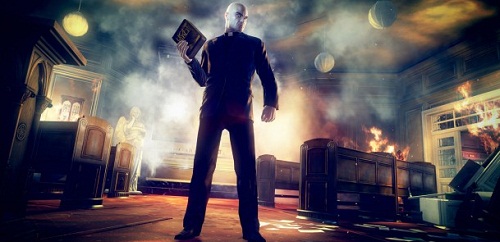
 I played Hitman: Absolution this week. Like everyone else I was disappointed by the radical departure from the original gameplay format, but I wasn't entirely distraught. I enjoyed myself. If the stealth system were separated out from the disguise system, and the balance struck a little more in favour of larger levels, I think the rest could have been quite palatable. More than that - these vignettes of blending into train station crowds, hunting nuns in cornfields and stalking cops on rooftops bring dashes of dynamism and variety to a formula that, dare I say it, stands to benefit from it.

Absolution also got me thinking about Hitman's oft-fraught relationship with narrative, and about how the bland cutscenery of the last two games seems to be missing the point. I love IO and I love these games - and I want to formulate something constructive. To do so I'll ask a simple question:

What is the point of Hitman's Narrative?
The narrative design in a game is there with one purpose, which is the same purpose as every other element in development - to help deliver an interactive experience that focuses on the controlling idea. The controlling idea is what the project is about. It's a description of what the end-user experience should be.

Hitman's controlling idea (its point) is plain enough: to be an expert assassin; to explore, understand and violently participate in a living world. By focusing on realistic environments, psychological judgements (or understanding of AI routines if we're being cynical) and calculated subterfuge over blind Rambo-ism, Hitman is, more than most stealth 'n gun games, a simulator. Albeit a simulator with a dark sense of humour.


How do you usually plot a simulator?
Usually not with cutscenes. The more popular alternative is simply to avoid plot altogether. A plot supposes some artificial linearity - some element of the game that isn't simulated, but locked in - and that would be opposed to the very concept of what a simulator is. Silent Hunter, SWAT 4, the various brilliant flight sims - they don't force you on a particular path. They give you enough background detail for context, then let you go off and create your own tale.

I'm not sure this is where Hitman's going. For one thing, Hitman is different from some other simulators in having a protagonist with a personality (sort of) and - so the argument goes - therefore you need a character arch, and a plot, and cutscenes... we know where this ends up. For another thing - and it seems strange to admit this - but I just can't imagine Eidos biting the bullet and accepting that they may not need a plot. Hitman is a AAA game, and AAA games have stories now!

So if we're committed to putting something in between the assassinations (and it is surely the assassinations that are at the heart of Hitman) what should it be?

How else could you design Hitman's narrative?
How about this: Career Mode. I'd argue that if we want anything from Hitman's narrative, it would be something that supports the simulation feel of the core gameplay. What's cool about 47 is not, I think, what he does when the people he works for betray him and he's left with a genetically engineered little girl to protect. What's cool about 47 is that he's a professional. A cool Hitman story would focus on that.

What would a year in the career of a Hitman be like? What would fill the gaps between the hits? I think there would probably be a bunch of the things you'd expect - upgradeable, explorable hideouts, collectable weapons, a currency based on mission success... You'd also want to make greater use of some other elements from earlier Hitman games - Blood Money's procedural newspaper articles could be developed into something that gave us a sniff of the larger world.

What might turn out to be particularly useful are those little vignettes from Absolution. A career mode would need something more than a few management elements to deliver the sense of being 47. We'd want to see just a little of the pain-staking preparation that goes on behind the scenes. So perhaps we'd have some side-missions: a trip to the blackmarket weapons dealer, a hit on a potential witness, a scouting mission on local police patrols. If we were really clever we'd have these develop and overlap in unexpected ways: perhaps on the scouting mission we'll spot the weapons dealer entering the police station. Depending on 47's actions he may come home from his next mission to find them knocking at his door.

What I suggest is that by building up this little web of fiction we could bring another layer of detail to Hitman's world. Instead of breaking from the core missions for another video of 47 being betrayed and not being caring about it, let's use that time to tell a different sort of story - one which reflects the core themes of the gameplay experience. One which makes you feel like a Hitman.

Friday, 19 October 2012

Ir/rational Investigator Heads to IGF 2013

This is, of course, no guarantee that it will actually arrive there. All the same, 3am this morning marked the deadline for this year's Independent Games Festival, and the Ir/rational team were unsurprisingly working up to the wire. It's been worth all the ball-ache of learning about ad-hoc dev profiles, text blitters and orientation bugs because finally we have a decently representative vertical slice. Finally we know where we're going with the game, and we can show people. I shall do so...

...now!

Rick's Office - serves as the HQ, and highly adaptable - the room reflects progress in the story.

The game map. The first episode will feature 3-4 such map screens, each with unique locations and characters.

The tone of the game is tongue in cheek.
So we've currently got about 20 minutes of gameplay. Over the next couple of months I'll be designing the remaining puzzles (the rough plot is already in place) with a view to releasing the first episode Some time in Q1 2013.

You can read more about Ir/rational Investigator at Steam Greenlight. Although Imre of Bossa Studios had a play the other day and said it was a "great idea, but shakey implementation" - so don't get too excited, because he knows his stuff!

Tuesday, 9 October 2012

Interview: Blendo Games on Quadrilateral Cowboy

Brendon Chung of Blendo Games has been responsible for some of the smartest, most varied and distinct indie games of the last few years, including Gravity Bone, Flotilla, Atom Zombie Smasher and Thirty Flights of Loving. I caught up with Brendon at PAX last month where he was exhibiting his new game, Quadrilateral Cowboy.

So, to start us off, tell us a little about your new game.

Sure. It's a cyber-punk 20th century 1980s low-tech hacking game.

Excellent. I've played it, I love it, it's I think my favourite game here. So your games, more than most, are incredibly varied. You've done a turn-based space sim, a zombie strategy game, more surreal things... and now you're doing a first-person stealth hack'em up. Is that a conscious decision on your part to try to nail as many genres as you can, or is it just the way it happens?

I'm not trying to nail as many genres as I can, it's more me trying to get out of my comfort zone. I'm a big fan of when people get out of their comfort zone and do something they're not used to doing. I love seeing when dramatic actors do comedies, I love seeing when comedians do dramatic roles. So for me, that's why. Flotilla was my first turn-based strategy game. I thought - I might as well give it a shot, see what happens.

So there's a theme across a number of your games and it's certainly got a surreal feel to it. How much of that is because you want to have control of your world, how much of that is to give you leeway in the gameplay, is it your style, is it just the way it comes out - tell us what goes on behind that.

So these are just things that I'm interested in like when I read books or watch movies... Woody Allen or the Coen brothers, they influence me a lot in that they have these worlds that are real, but at the same time be wildly fantastic about them.

OK. We talked yesterday about the writing. You said you wanted to keep the text in the new game minimal if even non-existent outside of the computer terminal system that you use; but I got the impression that you like to write, even if you like to keep it out of the games. Tell us a bit about your relationship with the writing.

Yeah, so I love reading, I was a film major in college and writing was one of the things I most enjoyed doing. But then when I play video games I am the type of player that skips past all the text bubbles and cutscenes because if I want to read a good story I will pick up a good book. So I feel like games are best served when  you're interacting with them, not reading pages of text. Although I will say, Planescape: Torment - best game ever made.

I love in that game because they didn't have that detailed animation it was prose, right? You know, "So and so looks at you with a steely gaze and says...". Seems very strange nowadays. So playing Cowboy, you've obviously got a world that functions according to a set of rules, and I love that because it makes the world feel more thorough. It feels real because everything functions independently, you put some stuff int he level and then it goes off and does its stuff, just like in the real world. How do you go about conceptualising that world and what do you think the game rules bring to the game? 

Thirty Flights of Loving and Gravity Bone are very narrative based, very experimental in terms of story. This one's the opposite of that. It's about really high player agency, letting the player run around a simulated cyber-punk world. I was kind of inspired by... Recently I've been a simulation kid. Games I've really liked have been Day Z, Dwarf Fortress, and those are games where it's just pure simulation and they let people be creative within them. That's something I want to support.

I went to the Erik Wolpaw and Tim Schafer talk earlier today about gameplay vs story and someone asked Tim, "How do you feel about games that express their meaning through mechanics rather than pre-authored script?" and he was kind of quite dismissive about it.

In what way?

Something like: "When I interact with a piece of art I feel like I'm communicating with another person, and if all I have is a bunch of mechanics and no pre-authored story then there's no communication." It sounds like you're saying the opposite and I think I'd probably be on your side. Um... that's not really a question...

*Laughs* Yeah, what games I feel excel in is interactivity, and being able to crunch a billion numbers behind the scenes. So an authored story is a form a lot of media can do, but player generated stuff - that's what's so unique to video games. 

Well done, it's almost like I fed you that. One more question . Stealth. I love it, I think you must enjoy it.

Thief is my favourite game of all time. Next to X-Com.

Why?

I like that it makes you roleplay a certain type of character. I think a lot of games now you're some muscle-bound guy and have 20 guns strapped to your back and that's fun, I enjoy that. but I like having variety in my gameplay, so when I played Thief I suddenly played this guy who had one hit point and a guard just looked at me the wrong way and I would drop dead. I'm hiding in a corner and I'm breathing shallowly and hoping he doesn't see me. There's something wonderful about that experience.

Good answer. Brendon, thank you.

You can keep up with Blendo here, and Quadrilateral Cowboy right here.

Monday, 1 October 2012

Guest Post: Speech v Silence - Why Less is More

Hi there. I’m Will Swarbrick. I used to write stuff for Gamer's Guide to Life, SystemLink, and a few bits and pieces that are forever lost in the wastelands of the internet. Before my new life as a History student in the Midlands commences, and in a bid to make a break in this topsy-turvy industry, Mr. Jubert has kindly given me the opportunity to discuss something of a growing concern; as scripts for games balloon and burgeon, dwarfing their cinema counterparts, story and narrative is becoming a greater focus for game developers - but story isn't all about speech. Sometimes, the best narratives are those crafted with complete silence.

The brilliant Critical Path series has contained within its star-studded vaults enough groundbreaking philosophy and astounding psychology (as well as a healthy dose of pomposity) to make any gamer duck and cover for all the ideas flying over their heads. However, one video stood out for me. While previous talking heads spoke of the importance of extracting real emotion from players, Joseph Staten, Director of Cinematics for the Halo series (not to be confused with Joseph Stalin, Director of Mass Murder for the USSR) came out with:

"I don't want to play a game that makes people cry[...] I wanna make a game that makes me go 'Yeah! Did you see what I did to that guy! That was so good'. Maybe it's challenging to make you cry...but games that make you jump up out of your chair and beat your chest - when was the last time a movie or book made you do that?”

The man has a point. Roger Ebert's dismissal of games as an art form by asking the question 'Has a game ever made anyone cry?' seems to have struck a nerve with the gaming community, and now the great gold rush is for a game that grabs your emotion gland and forces those salty tears to stain your controller. While there are a plethora of brilliant games that can manifest a lump in your throat, just spamming a cinema screen with pictures of dying puppies and Instagram'd sunsets is enough to get the waterworks going and probably evoke a numinous experience or two. Staten’s point is that games are a unique medium, with the ability to summon up a greater range of emotions than your average silver screen flick. To make you, in this example, sad because of the actions of others seems facile in comparison to conjuring others feelings games are inimitable in creating - such as unadulterated joy or fist-bumping success from your own actions and decisions, from saving the known universe.

But it goes further than that - unlike the fixed and eternal stories in the cinema, players of video games don't need to be guided and channelled through a set narrative. The finger-slicing scene in Heavy Rain sure was a brilliantly sickening and horrific piece, but felt more like a slightly interactive movie than a game. Often, the best narratives and strongest feelings stem purely from the player's free will, without the guidance of a linear fable. Mass Effect 2 was a game I struggled to get involved with for the same reason friends adored it; the world was thick with story. It was far too heavy with speech - jogging around the cityscapes of outer space, it felt like I was wading through a sea of deafening dialogue. Every few steps I was ambushed by a sidequest here and a dialogue tree there, barely able to move for the various narratives that blocked my path like a paperback Snorlax. There was no space for my imagination to sprint free and start to pilot my playthrough, for me to attempt to suspend cynical disbelief and imagine myself as part of this world - I was simply being ushered through futuristic corridors without any real input of my own, spare for the choice between a snarky response or a kind reply.

Oddly enough, it was Limbo, a game tightly glued to x-axis, that offered me the most freedom. There are no sweeping monologues or tomes of text - not a whimper or a whisper. Not a single word is uttered during the whole experience, and it's all the more engaging for it. Why is there a gargantuan spider chasing a hungry-eyed boy? Why do a group of kids attempt to spear our hero? What the hell happened to the hotel? By providing a springboard for an active imagination to roam, the game allows the player's mind to fill in the narrative gaps and blanks.

Could any linear narrative capture the magic of Skyrim when stumbling across a giant swiping at a dragon as mudcrabs nibble away at his toes, before your Thu'um stains the sky charcoal as bolts of lightning stab all those below? Could a planned and penned quest evoke more emotion than John Marston being abruptly ambushed in the middle of the desert, a volley of revolver shots scorching the landscape with piercing roars, only for all to fall deathly quiet as your attackers bleed onto the dust? Or, hey, jump in a Police Cruiser in GTA IV and become a vigilante to see my point. These personal moments are so unique and unexpected that they hit much harder than normal narratives. Sometimes, all that's needed to tell a great story is whole lot of atmosphere and a pinch of imagination.

Saturday, 22 September 2012

From Inside the PAX10 - Part 2/2


This is the second half of my post-PAX report. You can find the first half here.

Saturday - PAX Day 2
Saturday is the big day. That's the word going around the stands. The word is not wrong. Everyone is here. Surreal experience of the day goes to a certain gaming website that conducts a video interview. The interview is with their dolled up female presenter, who has the questions fed to her by the sweaty chap behind her. Perhaps she knows loads about games, perhaps the PAX10 is just not her area of expertise - but I worry the real reason she's being fed the lines is that the website thinks gamers are really here for the T&A. They won't be satisfied by thorough journalism! No, they want boobs!

Aside from this, I have a chance to check out some of the other games in detail, and am consistently thrilled to be sharing our part of the room with some of the most cutting-edge indies on the planet. A few stand out for me.

Octodad is a charming adventure game where you manipulate objects in 3D space not unlike (though rather better than) the interaction system in Penumbra. The physics gameplay is different and engaging, but it's the character and the potential of the adventure that excites me.

The Bridge I only play for ten minutes at the start of the day, but being set up nextdoor to us I'm watching it out the corner of my eye all day. If anything it gets slightly more 'Wow, that game is beautiful' comments than we do. We hang out with the game's developer, Ty Taylor, for most of the rest of the show and try to learn his secrets.

I'm also looking forward to playing Monaco, but that dream is quickly replaced by another - to play Brendon Chung's surreal, first-person stealth hack-em-up, Quadrilateral Cowboy. I've long been a fan of Blendo's games (Flotilla in particular) and Cowboy is by far my Most Must Have of the Show. It looks like Gravity Bone or 30 Flights of Loving, and plays like a surreal cross between Hitman and Uplink. Look at your map, find the infiltration points, complete your mission and get out. The twist is that every element in the game aside from movement is controlled via a command prompt on your in-game laptop, and success requires crafty coding and perfect timing. The game, for me, seems to be about establishing a limited but consistent set of rules, and then letting the player work everything else out. It's gorgeous, it's engaging, it's smart and it's fresh. Highlight? Pushing my beetle-like robot through a small hatch, testing the robot controls until I find the one for 'Jump', then watching through the glass window as the thing hops comically across the room and lands on the documents I need.

I had a chance to talk to Brendon later in the show, and I'll have the interview up in the coming weeks.

By the time the expo floor closes I'm doing my best to rally the indies to a single pub. This turns out to be far more than I can chew, and we end up going with Cypher Prime (Splice), Ty (The Bridge), Mango Down (Catch-22) and some others to a beer house round the corner, and then to the sitting-room-only pub where my bouncer story goes down. We bump into the Gearbox team, I get a bit drunk and rant-y about war games and bringing in writers who know nothing about games, and then we all get a bit more drunk and go to a club that closes at 1:30am because Seattle has backwards drinking laws (Olli, my boss, has already had to go home because he's 20).


Sunday - PAX Day 3
By midday on the last day I'm chest-deep in PAX-Pox - the generic flu thing that 80,000 gamers from all over the country import to Seattle each year - but I'm still finding new bits of the show, like the entire floor of PCs, or the competitive gaming. I head to the Penny Arcade Q&A and feel like what I'd guess a non-gamer must feel like walking into PAX - all the talk is around PA in-jokes and tabletop gaming, and it becomes clear to me just how vast Penny Arcade now is.

Otto and I also go to the Eric Wolpaw and Tim Schafer writing talk. They are excellent and funny, but something stands out. When asked how he'd deliver an engaging experience through mechanics alone, without the use of pre-authored narrative, Tim was nonplussed - if there's no author's hand at work, he says, how can we connect and communicate anything? I don't think I was the only person in the crowd who disagreed, and I'm sure on consideration he might redress that view, but the point was made - small studios are still where it's at if you want to do new things.

Once the show clears up I hook up with Brendon, Zach et al and head out for dinner. It's an absolute thrill to spend time with some of the devs I've most respected over the years, and it's over all too quickly. Once they shoot off I join Olli and Otto at the Indie Megabooth after-party at an Irish pub downtown. I meet a crazy man who works on a submarine, talk efficient cut scene narrative with Olli and Ty, and generally wind down. The boys have to shoot off to the airport around 1am, and I'm due to fly home tomorrow afternoon.

Monday / Tuesday - The Biggest mall in America
My flight out of Seattle, of course, is delayed by a couple of hours, meaning I miss my connection and spend 24 hours in Minneapolis. Everyone at the airline keeps apologising, but while I would have liked to get home it does mean I get at least one day of sight-seeing in the US - and on the airline's money too. I arrive at the rather nice hotel, order two pints of beer in plastic cups because it's 11pm and the bar's closing, hook up with a couple I meet outside who happen to have come from a tabletop convention, and we drive to TGI Fridays, which we're told is the only local bar still open.

The next day I go to the only tourist attraction within walking distance (and it takes quite some convincing for the hotel staff to let me turn down their free shuttle) - the biggest mall in America. The advertising is not inaccurate  There is an entire indoor theme park in the middle of the thing. I eat the local speciality (beef burger stuffed with American cheese), having failed to convince them to serve it anything other than well-done. I sample about 20 chilli sauces. I get on Facebook and complete dares set by my flatmates. Then I head to the airport, spend my $12 airline meal vouchers on the largest McDonalds meal money can buy (only $7, but HUGE) and settle in for the long flight home.

PAX was eye-opening for me. Sitting at home most days turning out script I'm somewhat cut off from video game culture. I don't know who plays my games, or why they like them, if they do. I aimed to spend PAX networking with the big boys, but instead I was drawn, at every moment, towards the indies. I've no great passion for cosplay or the latest wargame or having a mohawk shaved into my head so I can skip the Far Cry 3 queue. This, quite obviously in retrospect, puts me in a rather small minority at PAX.

What was great about the show was that I never felt that way. Hanging out with the indies, learning what people think of our game, and being re-enthused to develop ground-breaking product was what PAX was about for me - and it delivered in spades.

Friday, 14 September 2012

New Release - FTL: Faster Than Light

As of today (and until 21st September) you can buy FTL direct from the developer for the low, low price of about £6.50. I strongly urge you to do so.

With the cash they raised from kickstarter, the chaps at Subset have dramatically increased the scope of the game. I've helped them to develop a galaxy full of alien rogues, fast talking Slugmen and drunken pirates. They've added a host of new player ships, weapons and gadgets, and have been honing the product to perfection over the past 6 months.

I think it really is quite a game, and I hope you do to.

You can also pick up the game on Steam.